
Modernizing core enterprise infrastructure is one of the highest-stakes maneuvers a leader can undertake. Whether updating a critical ERP, a global Client Success platform, or a public-sector operations engine, transitioning off legacy software is rarely just a technical upgrade; it is an operational, financial, and organizational stress test. When a legacy cutover goes wrong, the failure isn't contained to IT. It spills directly into front-line operations, corrupts customer data, locks up workflows, and exposes the organization to severe operational and reputational risk.
True modernization requires far more than clean code and vendor promises; it demands rigorous leadership, risk management discipline, and uncompromised operational controls. To help enterprise leaders and implementation teams prepare for major initiatives kicking off in Q1 2027, this five-part series breaks down the non-negotiable tactical frameworks required to execute seamless legacy transitions.
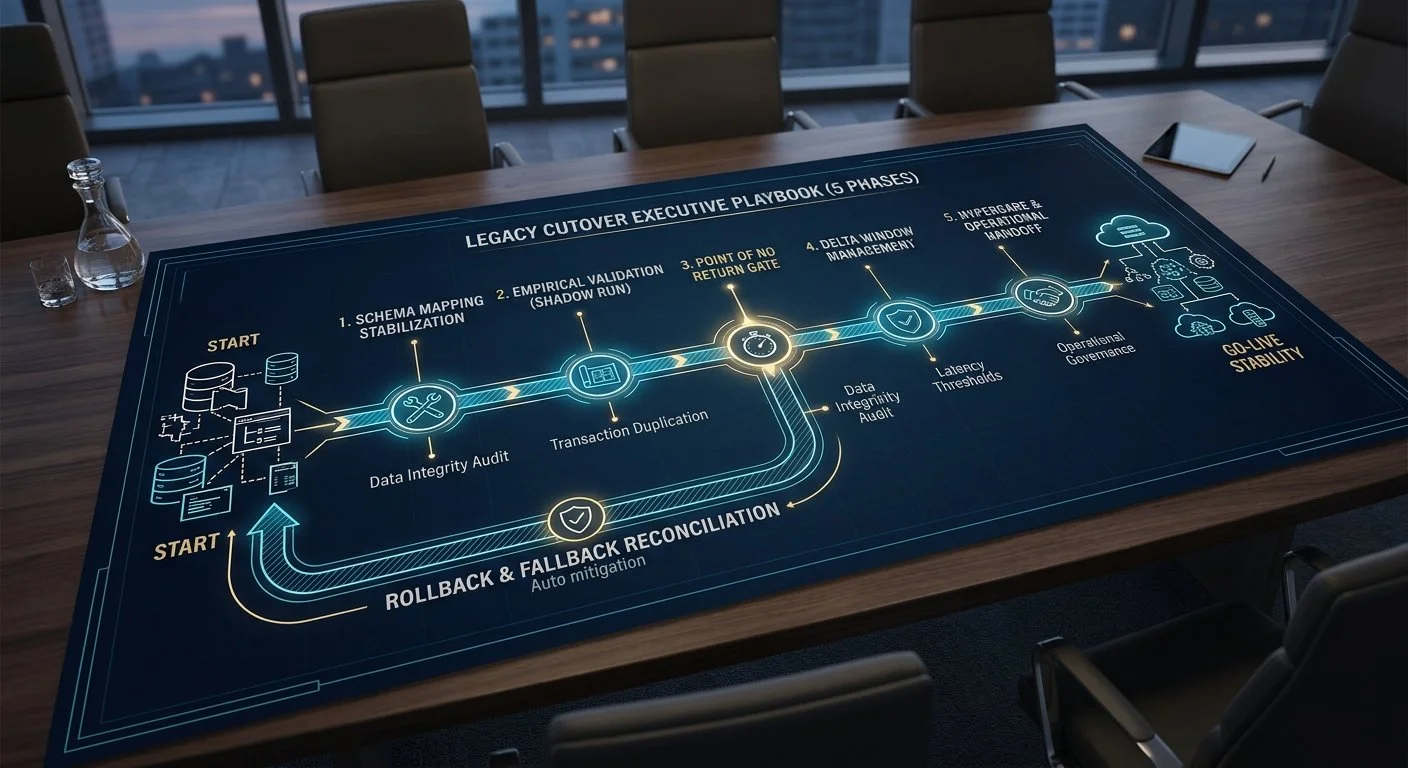
Here is a look at the five core disciplines we will cover in this series:
Part 1: Schema Mapping & The Hidden Trap of Legacy Data
Decades of operational workarounds, unstandardized free-text fields, and implicit rules make legacy databases a minefield for new systems. Part 1 focuses on the critical discipline of pre-cutover data auditing, field reconciliation, and schema mapping; ensuring bad historical data doesn't break clean modern architecture long before deployment day.
Part 2: Shadow Testing & Parallel Runs (Validating Truth Before Go-Live)
Testing software in a sterile sandbox environment is easy; validating complex business logic against real-world operational friction is where risk is mitigated. Part 2 explores why running modern and legacy platforms concurrently with live data streams is the only reliable way to expose hidden calculation errors, workflow bottlenecks, and system anomalies before flipping the cutover switch.
Part 3: Defining the Fallback Protocol & The "Point of No Return"
Hope is not a change-management strategy. Part 3 establishes the operational criteria every leadership team must define before launch: objective go/no-go metrics, hard cutoff windows, clear authorization channels, and pre-planned rollback protocols that prevent a minor deployment glitch from spiraling into a systemic operational crisis.
Part 4: Managing the "Delta Window" & Data Reconciliation
Rolling back a failed system deployment is never as simple as flipping a switch back to the legacy server. Part 4 tackles the high-risk "delta window", the operational period between go-live and rollback, and details how to audit, verify, and back-populate transactions so data integrity remains intact when systems desynchronize.
Part 5: Operational Continuity & Ground-Truth Verification
When digital tools fail or degrade during a transition, operational integrity relies entirely on leadership protocols and human verification systems. Part 5 examines how to maintain line-level continuity, train teams for manual fail-safes, and preserve cross-functional transparency so business output holds firm regardless of system stability.
Are Your 2027 Modernization Plans Ready for Real-World Friction?
As enterprise budgets unlock and new implementation cycles launch in the coming year, the difference between a high-performing cutover and a costly operational setback comes down to disciplined leadership long before day one of deployment.
Follow along over the coming weeks as we dissect each of these five tactical pillars and equip your organization to execute your next legacy migration with absolute confidence, precision, and resilience.