

BLOG POSTS
The Principle of Radical Ownership
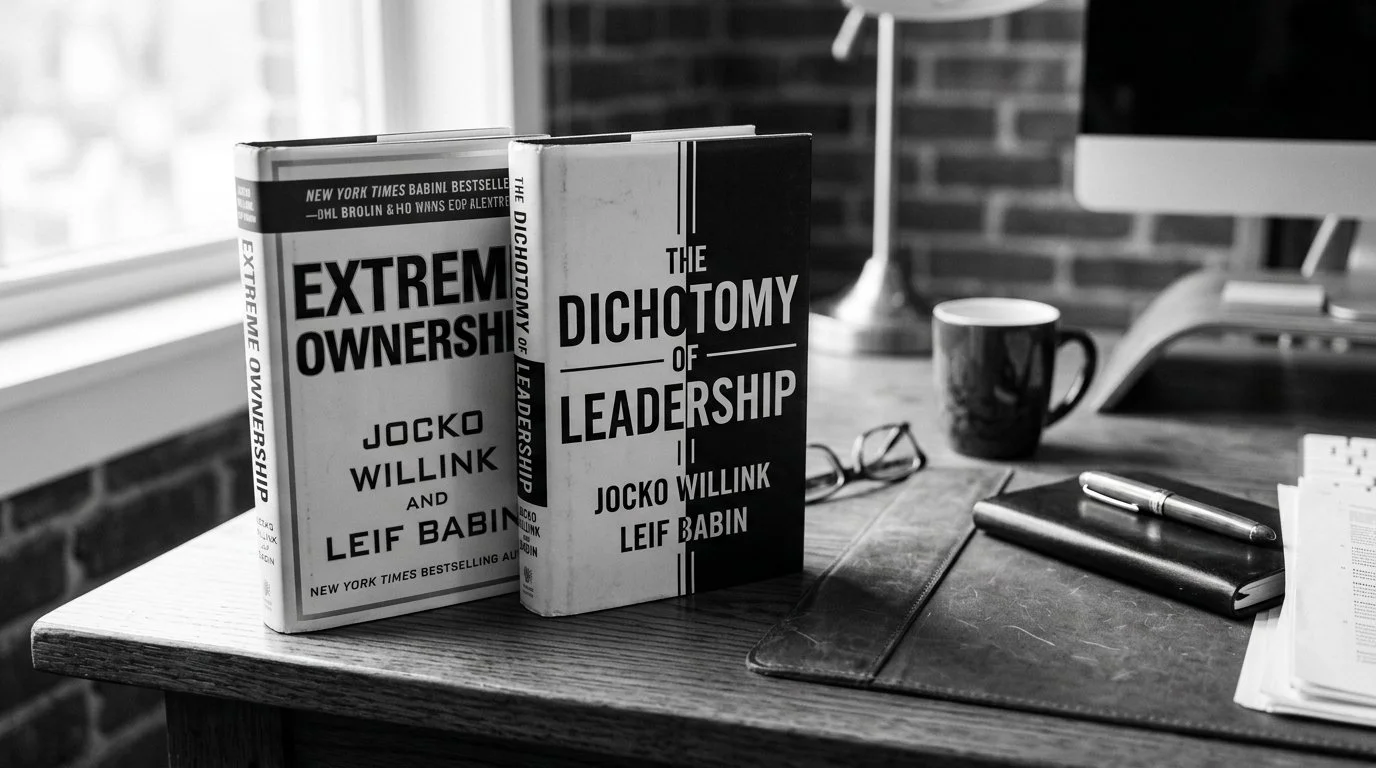
"Leaders must own everything in their world. There is no one else to blame."
— Jocko Willink & Leif Babin, Extreme Ownership
"Extreme Ownership is the foundation of good leadership. But leadership seldom requires extreme ideas or attitudes… leadership requires balance."
— Jocko Willink & Leif Babin, The Dichotomy of Leadership
True leadership begins the moment you stop looking for excuses and start looking in the mirror. In Extreme Ownership, Jocko Willink and Leif Babin establish the uncompromising standard that a leader must own every failure, friction point, and missed target within their domain. Yet, as they clarify in The Dichotomy of Leadership, taking total ownership is not about absorbing blame in isolation or micromanaging every step. Radical ownership is an act of empowerment. When a leader accepts ultimate accountability for results while granting teams the space to execute, they replace defensive finger-pointing with operational agency.
Protecting one's ego creates a blind spot that allows systemic failures to persist. When executives externalize blame, they signal that self-preservation matters more than solving the problem at hand. Radical ownership forces a departure from defensive posture, compelling leaders to examine where their own direction, support, or follow-through fell short. By prioritizing truth over comfort, a leader replaces excuse-making with a relentless focus on continuous improvement.
The dichotomy of ownership lies in using ultimate accountability to elevate others, not to hoard control. When a leader steps forward to absorb executive heat for a missed objective, they create a protective canopy for their team to analyze mistakes candidly without fear of retribution. Yet this stewardship must flow upward as well. When resources are constrained or directives from above lack clarity, radical ownership requires leading up the chain—proactively educating senior leaders, offering solutions, and driving alignment. By owning outcomes in every direction, a leader bridges the gap between executive intent and frontline execution while empowering their team to solve problems on the ground.
High-agency behavior is contagious, but it must be modeled at the top. When a leader openly admits a lapse in direction or strategy, it strips away the fear of admitting error across the entire organization. This transparency creates psychological safety, replacing a culture of finger-pointing with one of collective problem-solving. Team members stop hiding operational friction and begin stepping up to resolve issues on their own initiative because they see their leader doing the exact same thing every day.
Extreme ownership is an ongoing practice, not a destination. Systems, teams, and markets are in constant motion, and friction is guaranteed. Leaders who embrace this reality reject complacency, continually evaluating their own alignment, communication, and execution down and up the chain. By committing to radical ownership as a daily standard, you ensure that your organization remains adaptable, courageous, and constantly striving toward operational excellence.