

BLOG POSTS
Why Change Efforts Stall: The Cost of Systemic Inertia

How often do we allocate significant resources to organizational development (OD) and behavioral coaching, only to watch the resulting change efforts stall just short of impact?
Too often, these high-investment programs—especially those targeting mid-level management or Client Success teams—are at risk of not yielding sustained results. Why do we keep funding a change machine that seems to stall shortly after deployment?
The core challenge isn't a lack of commitment; it's often a profound misunderstanding of systemic inertia.
The Reality of the Flow: A Necessary Lag Time
I was recently struck by Dr. David M. Robertson's candid metaphor (Org/Ldr Development Is Piss In the River) regarding organizational development, which simplifies this complexity: The moment you stop the source of a problem, the system is still carrying what was already in motion.
In essence, stopping the undesired behaviour doesn't instantly deliver clean results. There is an unavoidable lag between the intervention (stopping the source) and the resolution (clearing the downstream effects).
It’s easy for leaders to mistake this crucial lag time for failure. They lose patience, overcorrect, or abandon the effort entirely, ensuring the system never fully flushes out the old, ineffective patterns. This impatience is the single greatest destroyer of strategic change initiatives.
Overcoming Organizational Inertia
To succeed, we must view behavior modification through the lens of Newton’s First Law: The Law of Inertia. Change requires a sustained force to overcome two critical sources of resistance:
1. The Inertia of Habit (Mass)
The "mass" of a team or individual is the deeply rooted strength of their existing habits and comfort levels. A ten-year-old process, even a poor one, has immense behavioral mass. Your coaching, new structure, or L&D program is the external force applied to overcome that mass. This force must be intense enough to start the movement, but more importantly, consistent enough to keep it moving. A one-day training seminar is merely a tap; a structured, perhaps a three-month accountability loop is the more likely, sustained force required.
2. The Inertia of the System (Momentum Transfer)
Once an individual or team accelerates into a new behavior, that momentum has a great chance of transfering to the adjacent systems—reporting, collaboration, approvals, and metrics. This is the ripple effect that takes time to clear the "downstream" effects of the old habits. For example, a client success manager using a new, proactive approach will inevitably expose flaws in the underlying ticketing system or billing process. This exposure is not a failure of the new behavior; it's a step in the successful transfer of momentum forcing the system to change.
The Mandate for Strategic Patience
The great differentiator for C-Suite leaders is not speed of intervention, but strategic patience—the discipline to wait for the effects to clear while maintaining a consistent force.
Leaders who rush to judgment—who "drink from the river too soon"—are likely to create instability. Their teams may learn that no plan will last long enough to matter, making future inertia even harder to overcome.
True success involves:
Locating the source of the problem and applying a measurable, sustained force (coaching/accountability).
Monitoring the system with objective data to verify the source has stopped.
Allowing sufficient time for the inherent inertia of the organization to dissipate the old effects.
Stop funding sprints for marathon races. Leadership in organizational development is less about heroic, one-time pushes and more about the quiet, disciplined application of consistent pressure.
What is one legacy habit in your organization where you have prematurely abandoned the force required to see the results clear downstream?
The Physics of Professional Entropy: Defying the Drift toward Mediocrity

Have you ever observed how quickly a highly optimized system can degrade without vigilant intervention? A perfectly tuned data center slowly accrues technical debt. A streamlined process becomes clogged with exceptions. A high-performing team begins to tolerate small inefficiencies. This isn't a moral failing; it is the Second Law of Thermodynamics at work.
This fundamental principle of physics states that the entropy, or disorder, of an isolated system will always increase. In the vacuum of a closed environment, complexity naturally spirals toward chaos. For the seasoned professional—in Information Technology, Information Systems, or Client Success—this manifests as professional entropy: the natural drift toward skill obsolescence, process decay, and strategic stagnation.
The critical insight is this: Your professional life, your team, and your organization are NOT isolated systems.
Your Organization as an Open System
To defy this natural, downward pull toward mediocrity, we must view our organizations as open systems—entities that exchange matter, energy, and information with their environment. The fuel for battling professional entropy is not just budget, but high-quality, directed energy:
Directed Information: Strategic market intelligence, customer feedback loops, and advanced technical knowledge.
Directed Action: Rigorous process re-engineering, intentional skill development, and purposeful relationship building.
Directed Investment: Focused allocation of resources (time, capital, and talent) that yields sustainable order.
The ability to successfully defy this natural drift toward chaos lies in purposeful strategic leadership and execution.
The C-Suite's Guide to Entropy Management
How does a strategic leader systematically combat the decay of professional and organizational excellence?
1. Acknowledge the Default State
Accept that complacency and technical debt are the path of least resistance. The moment you remove focused effort, degradation begins. This is not a failure of morale; it is a law of nature. Where is your organization currently allowing disorder to become the norm, and what is the cost of that neglect?
2. Define the High-Order Architecture
Disorder can only be fought with a clearly defined structure of order. In a technical or client-facing environment, this means defining a Desired State Architecture for your team, your technology stack, and your client relationships. What are the key performance indicators (KPIs) of an optimally "ordered" system, and what is the strategic value of that order?
3. Invest in High-Leverage Energy Inputs
Not all effort yields equal results. Low-leverage activities—reactive troubleshooting, repetitive administrative tasks, and participation in non-strategic meetings—consume energy while only minimally reducing entropy. High-leverage inputs are those that inject powerful, directed energy into the system:
Strategic Automation: Eliminating routine disorder by converting it into predictable, automated processes.
Deep Skill Development: Focusing development on future-proof capabilities that enhance intellectual capital.
Client Relationship Rigor: Transforming reactive service into proactive, strategic partnership and value delivery.
Are your teams confusing activity with output, and are you optimizing for effort or for results?
4. Practice Intentional Redirection of Force
A great leader does not waste energy fighting every small force of resistance; they redirect the most powerful forces to a productive end. Think of an enterprise-wide transformation. The inherent resistance (the 'energy' of entropy) can be redirected by anchoring the change to a clear, undeniable business objective, thereby converting resistance into momentum. Which existing organizational forces—be it the pressure of quarterly results or a major client initiative—can you redirect to drive your most critical strategic objectives?
By embracing the reality of professional entropy, you move beyond simply reacting to problems. You position yourself as the intelligent force of order, systematically investing energy to build and maintain a beautiful, highly-ordered system of professional and organizational excellence. The purposeful life is not a gift; it is a meticulously engineered defiance of chaos.
The Leader's Blind Spot: Assembling Our Own Biases

The Leadership Challenge: Falling in Love with Our Own Creations
Have you ever been deeply involved in deploying a complex system, architecting a new client success process, or overhauling an entire IT infrastructure, only to find yourself irrationally protective of the final result? Even when the system is clunky or the process inefficient, there's a pull to defend it simply because you and your team poured months of effort into its creation.
This sentiment is rooted in a well-documented cognitive bias known as the "IKEA Effect": the psychological phenomenon where we place a disproportionately high value on things we have created or contributed to. While this may be a harmless quirk when assembling flat-pack furniture at home, in the high-stakes world of enterprise IT and Client Success, this cognitive attachment becomes a strategic blind spot. It prevents leaders from objectively assessing performance, inhibiting the brutal honesty required for digital transformation and sustained client health.
The Stifling Grip of Attachment in Technical Organizations
When you, as a leader, or your high-performing technical team, builds something from the ground up—be it a scalable SaaS platform, a security framework, or a core client integration workflow—the natural inclination is to fall in love with it. This emotional tie can manifest in three critical ways that hinder organizational agility:
1. The Erosion of Objective Critique (Groupthink)
The team that built the product often shares a deep, collective investment in its success. This "we built this" mentality fosters a subtle form of groupthink. It creates an unspoken agreement to overlook technical debt, dismiss legitimate external feedback from users or clients, and resist fundamental changes that threaten the original architecture.
For leaders, this means you are failing to cultivate a culture where the team feels safe and empowered to challenge their own work. In technology, where the rate of change is exponential, an inability to objectively self-critique the very structure you built is a direct path to obsolescence and competitive disadvantage.
2. The Trap of Controlling the Detail (Micromanagement)
A deep, personal connection to a project often fuels the belief that no one else can care for it as much as you do. This leads directly to micromanagement—a reluctance to delegate and an urge to control every detail, from high-level strategy down to the smallest implementation logic.
This behavior, driven by attachment, stifles the creativity, growth, and autonomy of your senior contributors. It sends a clear non-verbal cue that you do not trust their competence or judgment. This ultimately pushes away valuable talent and limits the scalability of the very system or process you are trying to protect. Strategic leaders must transition from being the doer to being the enabler and accountability partner.
3. Professional Relationships Built on Validation, Not Truth
When your attachment to a system is visible, it subtly pressures team members to validate your creation rather than speak the necessary, objective truth. This is a breakdown of professional relationship building. True leadership and mutual respect are built on the ability to have candid, data-driven conversations about failure and inadequacy without fear of emotional reprisal.
The Path to Strategic Detachment
To overcome the 'IKEA Effect,' leaders must first admit their susceptibility to it. The strategic imperative is to intentionally separate your identity and ego from the work produced. You can cherish the effort and commitment that went into the creation without allowing it to cloud your objective judgment regarding its future viability.
A great leader knows when to be the visionary and when to be the objective, dispassionate critic.
Consider implementing a structured approach:
Establish a "Break It" Culture: Formally assign a rotation of seasoned contributors or a specialized "Red Team" whose singular mandate is to intentionally find flaws, inefficiencies, and ways to "break" the system or process. This externalizes the critical function and legitimizes honest critique.
Insist on Data-Driven Accountability: Anchor every performance review, project retrospective, and strategic pivot in objective metrics—client adoption rates, system efficiency, ROI, or churn metrics. Data cuts through emotional attachment.
Empower Ownership, Not Just Tasks: Delegate genuine ownership over entire functions or modules. By fostering a culture where others are fully accountable for the success and failure of a component, you transform your personal investment from a bias into a powerful catalyst for continuous, distributed improvement.
By leading the way in professional detachment and fostering a culture of rigorous, constructive feedback, you ensure that your organization remains agile, innovative, and focused squarely on delivering maximum client and business value, not on protecting past effort.
What is one piece of technology or a process in your organization that you suspect your team has an unhealthy emotional attachment to, and what objective metric could you introduce this week to challenge that bias?
The Leadership Crucible: Why Comfort is the Enemy of Greatness
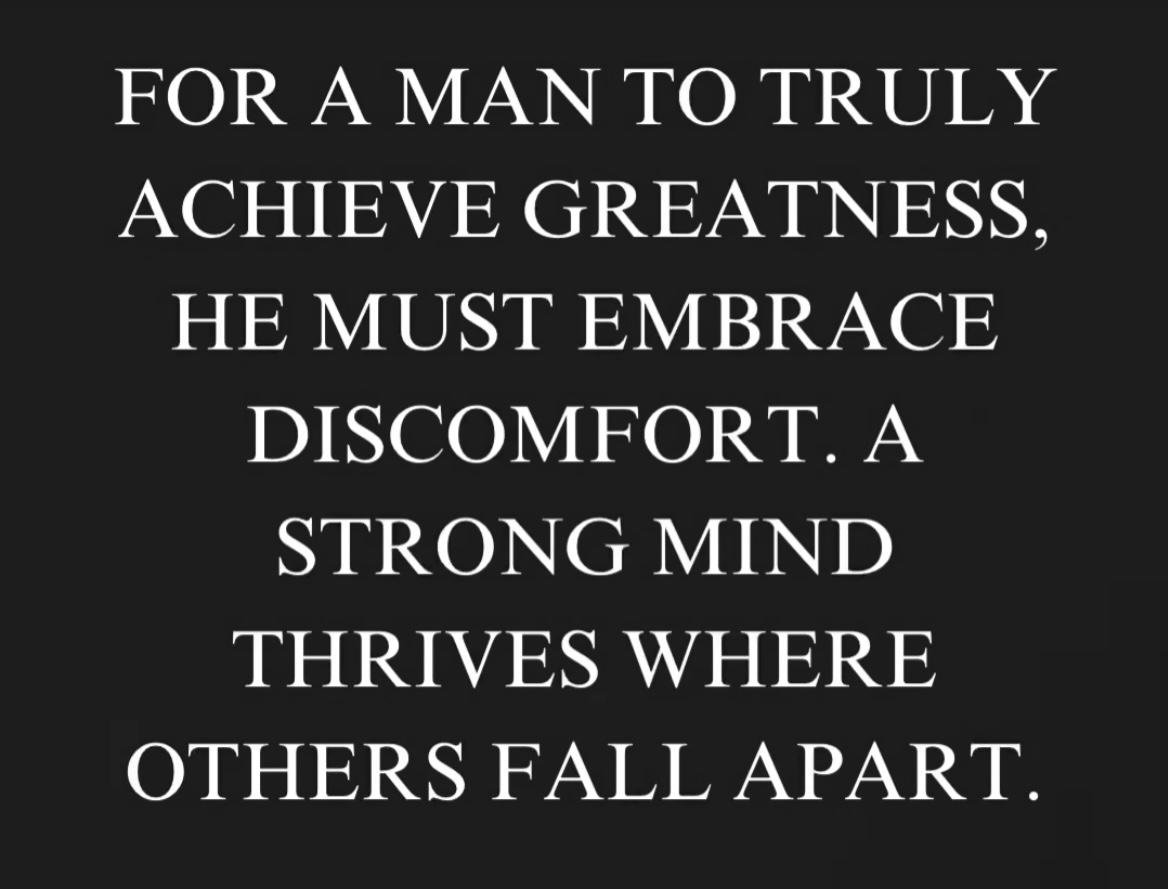
In the volatile landscape of enterprise Information Technology and Client Success Management, a pervasive myth distracts even the most seasoned professionals: that the path to operational greatness is paved with smooth transitions, optimized processes, and minimal friction. This is a profound and strategic misdirection.
For the senior leader or seasoned individual contributor operating at the nexus of technology and business outcomes, the most significant leaps—the enduring competitive advantages—are not forged in the absence of struggle, but in its very core. The pursuit of greatness is not about avoiding discomfort; it is about the deliberate and strategic seeking of friction, for it is only in that crucible of challenge that the resilient, strong mind required for digital transformation and scale is forged.
The True Nature of Professional Discomfort
In our world, discomfort is rarely physical. It is the intellectual and emotional weight of high-stakes situations:
The pivotal, challenging conversation with an executive stakeholder whose vision is misaligned with the technical reality of the roadmap.
The humility and strategic courage required to admit a multi-million-dollar technology bet must be scrapped and course-corrected.
The unrelenting cognitive load of maintaining composure and critical thinking during a system-wide incident or a market-disrupting pivot.
The necessary confrontation of a long-standing, inefficient process that is culturally entrenched within the organization.
These moments are not obstacles to be lamented; they are the critical stress tests that force the retirement of obsolete habits and demand a level of resilience that cannot be simulated. By willingly stepping into these high-pressure, uncomfortable situations, the leader reclaims their strategic agency and proves that their capacity to lead through complexity is unlimited.
Building the Strong Mind: A Strategic Imperative
The concept of a "strong mind" is not a personality trait; it is a developed, operational capability. It is the muscle built through consistent, disciplined action under duress.
The mind that can not only endure but thrive where others fall apart is not one that has dodged hardship, but one that has been strategically tempered by it. This is the ability to:
Maintain strategic clarity when operational chaos is at its peak.
Execute critical, unbiased decision-making when team morale is low or emotions are running high.
Exhibit the discipline to persist on a difficult strategic goal when the path of least resistance—quitting—is most tempting.
Tactics for Cultivating Strategic Resilience
For the leader focused on building this capacity for themselves and their organization, the action is deliberate:
Seek Out Uncomfortable Truths (The Strategy Audit): Actively establish channels for unvarnished, high-fidelity feedback—from executive peers, the operational floor, and key clients. Unvarnished insight is not a personal critique; it is the prerequisite for genuinely corrective action and strategic alignment.
Embrace the "Hard Choice": When faced with a task that requires marginal effort versus one that demands a breakthrough in thinking or process, consistently choose the latter. This is how you build a reliable track record of strategic obstacle mastery.
Mandate Deliberate Reflection (The After-Action Review): Post-mortem a challenging project or failure, not to assign blame, but to extract systemic, repeatable lessons. Codify what was learned about yourself, the team’s operating model, and the underlying technical strategy.
Leading Through Friction to Achieve Scale
This personal commitment to intellectual discomfort has a profound, force-multiplying effect on the organization. A leader who visibly models this behavior creates a fundamental shift in team psychology. When you are transparent about the difficulty of a challenge and your strategic approach to overcoming it, you implicitly give your team permission to struggle without shame.
This organizational culture transforms failure from a liability into an invaluable instructor, and ensures that systemic challenges are met with collective, determined problem-solving rather than individual fear or deflection.
Ultimately, the choice to embrace discomfort is a strategic investment in your long-term success and that of your technology function. It is a commitment to building a foundation of mental fortitude that will serve you through the next cycle of market disruption or digital transformation. By choosing the path of friction today, you secure your ability to lead with unwavering strength, clarity, and authority tomorrow. The most meaningful victories are not found by avoiding the struggle, but by winning the most difficult ones.
The Unspoken Architecture of Leadership

If you are anything like me, you operate in an industry where precision, logic, and data reign supreme. Every digital transformation roadmap, every critical infrastructure decision, and every budget proposal is meticulously engineered for optimal outcome. Yet, here is the pressing challenge common to every large-scale technology organization: If our strategies are perfectly rational, why do our critical communications—the vendor negotiations, the board presentations, the team-wide pivots—so often fall short of their intended impact?
The truth is, while we focus intensely on what we say, the decisive competitive edge in enterprise leadership is often determined by how we say it and how we show up. The most brilliant strategic vision remains just a document until it is communicated with conviction and received with trust.
This realization led me to Cues: Small Signals, Incredible Impacts by Vanessa Van Edwards. This book is not about mere "soft skills"; it’s a critical read for any senior IT/IS professional who understands that leadership at our level is a high-stakes performance, where the smallest non-verbal signal can either forge trust or introduce crippling doubt.
Here is an executive summary of the cues that resonated most deeply with me and provided direct, actionable insight into elevating our day-to-day engagement with our teams and stakeholders:
Part I: The Strategic Presence – Leveraging "Power Cues"
In the environment of enterprise IT, presence is power—not the power of hierarchy, but the capacity to command attention, articulate certainty, and foster an environment where productive disagreement can thrive, leading to better decisions.
Power Cue #1: Powerful Posture
This is fundamental. Whether you are leading a $100M vendor negotiation or addressing the leadership team after a critical incident, your posture is the first piece of data the room processes. When we are defensive, uncertain, or disengaged, our body language contracts, signals low status, and invites questioning. Powerful Posture—open shoulders, an upright but relaxed frame, and occupying space—communicates competence and resilience. It signals to the room: “I am calm, I am confident, and I am in control of this conversation and the situation at hand.” This is paramount for establishing the psychological safety needed to move complex initiatives forward.
Power Cue #5: Palm Power
Effective leadership demands transparency and a commitment to moving past hidden assumptions. Van Edwards highlights how showing your palms—a gesture historically associated with demonstrating one holds no weapon—is a powerful cue for trust and openness. When you are presenting a solution or asking your team to commit to a difficult initiative, using open-palm gestures makes your delivery appear more honest and authentic. It is a non-verbal confirmation that your motivations are pure and your proposal is well-intended, significantly lowering the audience’s defensive barriers and encouraging buy-in.
Part II: The Vocal Architecture – Mastering "Vocal Cues"
The voice is the delivery mechanism for our strategy, yet many leaders have never truly trained this instrument. Now that remote and hybrid meetings are a constant, the vocal signal is often the only signal we transmit.
Vocal Power Cue #1: How to Sound Confident
Confidence in speech is less about volume and more about control and cadence. Confident speakers avoid "uptalk" (raising the pitch at the end of a statement, turning it into an unintentional question) and utilize strategic pauses. Pausing before a key point not only allows the information to land but also demonstrates self-assurance. It says, “I know what I am about to say is important, and I trust you will wait for it.”
Vocal Power Cue #3: Eliminate Vocal Fry...Forever
While a seemingly minor point, vocal fry (the low, creaky sound at the end of a sentence) disproportionately erodes credibility, particularly in high-stakes environments. It is often perceived, rightly or wrongly, as a sign of apathy, insecurity, or lack of gravitas. As senior leaders, we must be polished communicators. Eliminating this cue ensures that the focus remains on the strategic content and not the vocal distraction.
Vocal Power Cue #4: Volume Control Shows Emotional Control
When under pressure—be it a system outage or a contentious budget review—our natural tendency may be to raise our voice. However, the most emotionally controlled leaders master strategic volume control. A measured, steady volume conveys stability and strategic command. Furthermore, lowering your voice slightly at a critical juncture can force the listener to lean in, capturing their full focus and demonstrating that you are handling the pressure with calm authority.
Vocal Warmth Cue #1: Make a Memorable Vocal First Impression
Warmth is how we build trust. Your vocal first impression should convey that you are not just a technical automaton, but a human leader invested in solving a problem with your audience. This involves using an engaging pitch and a slightly faster-than-average pace to demonstrate enthusiasm, followed by a slight, strategic slowing to ensure clarity and gravity.
Vocal Warmth Cue #3: How to Sound More Interesting
Monotone delivery is the enemy of engagement, particularly when discussing complex technical roadmaps. To sound more interesting, employ vocal variety—changing your pitch, pace, and projection. Emphasize key data points or strategic imperatives with a slight drop in pitch and a deliberate pause. This variation ensures that your audience remains engaged and that your core message penetrates the noise.
The Charismatic Word Choice
Charismatic communication—in both verbal presentations and written executive summaries—is achieved by shifting from technical nomenclature to language that invokes vision and benefit. Instead of focusing on tool names or process steps, focus on the impact to the business, the value created, and the future state you are pursuing. Use powerful, evocative words to frame challenges as opportunities and operational shifts as strategic leaps. This helps you engage your audience not just on a logical level, but on an aspirational one, driving momentum toward organizational goals.
Call to Action
Effective leadership is about maximizing impact through deliberate execution. I highly recommend adding Cues: Small Signals, Incredible Impacts to your reading list. Master these small signals, and you will begin to observe the incredible impact on your ability to lead, persuade, and drive strategic outcomes across the enterprise.