

BLOG POSTS
The Architecture of Quietude: Auditing the Executive Soul

When the stakes are high and the room goes quiet, here’s something worth pondering: What does your internal monologue sound like in that moment? Is it steady and grounded—or busy, calculating, and afraid of what might slip through your fingers?
In the middle of a high‑pressure initiative, it’s easy to get wrapped up in the mechanics—P&L swings, operating metrics, client dynamics, delivery timelines. Those things matter. But beneath all of that is something more fundamental: who you are being internally while all of this is happening.
Marcus Aurelius once asked a question that still lands hard today:
“What are you afraid of losing, when nothing in the world actually belongs to you?”
That idea isn’t about disengagement or indifference. It’s about ownership versus stewardship.
If you see your role, your team, and even your results as possessions to protect, anxiety is almost guaranteed. But if you see them as a trust you’ve been asked to steward well, something shifts. The internal posture moves from fear to responsibility—from tension to quiet authority.
Your Internal Narrative Is the Blueprint
The conversation you have with yourself is the foundation of your executive presence. It determines whether people experience calm leadership or reactive management when you walk into the room.
Something else worth asking: When you listen closely to that internal narrative, do you hear the voice of a disciplined steward—or someone feeling pushed around by circumstances?
There’s a line from Proverbs that has followed me for years:
“Keep your heart with all vigilance, for from it flow the springs of life.” (Proverbs 4:23, ESV)
In leadership terms, those “springs” are the clarity, steadiness, and integrity you bring into every interaction. If the source is cluttered with fear—fear of loss, fear of being wrong, fear of slipping status—then the output will reflect it.
Sometimes the most meaningful impact we have on a team isn’t our technical expertise or our grasp of the operating cycle. It’s the discipline of remaining composed when things get uncomfortable.
Cultivating the Warrior Within
I think it helps to reframe leadership here. Leadership isn’t a machine you maintain. It’s more like a garden you cultivate. Processes, systems, and metrics matter—but they’re secondary. The vitality of the steward comes first. When you focus on what’s happening inside, you’re building durability, not just output.
That inner discipline shows up in very practical ways:
Clearer communication - When you’re not worried about “losing” an argument, you can listen long enough to hear what’s true.
Composed conflict resolution - When your identity isn’t tied to being right, you can guide the group toward the best answer—not just your answer.
Better stewardship over time - When the enterprise is a trust instead of a trophy, decisions naturally shift from short‑term survival to long‑term sustainability.
This is where quiet strength pays dividends.
A Moment of Self‑Consultation
As you look toward the next quarter, it’s worth pausing—not to review metrics, but to ask a deeper question: Is my leadership built on temporary gains, or on an unshakeable internal state?
The outcomes we see—team trust, peer respect, financial health—are often lagging indicators. They reflect the person we are becoming when no one is watching. And if nothing in this world truly belongs to us, then something freeing happens.
We’re less afraid.
We’re more grounded.
We lead with confidence that isn’t brittle.
That’s the kind of stewardship organizations quietly rely on—and the kind of leadership worth cultivating.
The Core Metric: Is Your Success Architecture Truly Client-Centric?
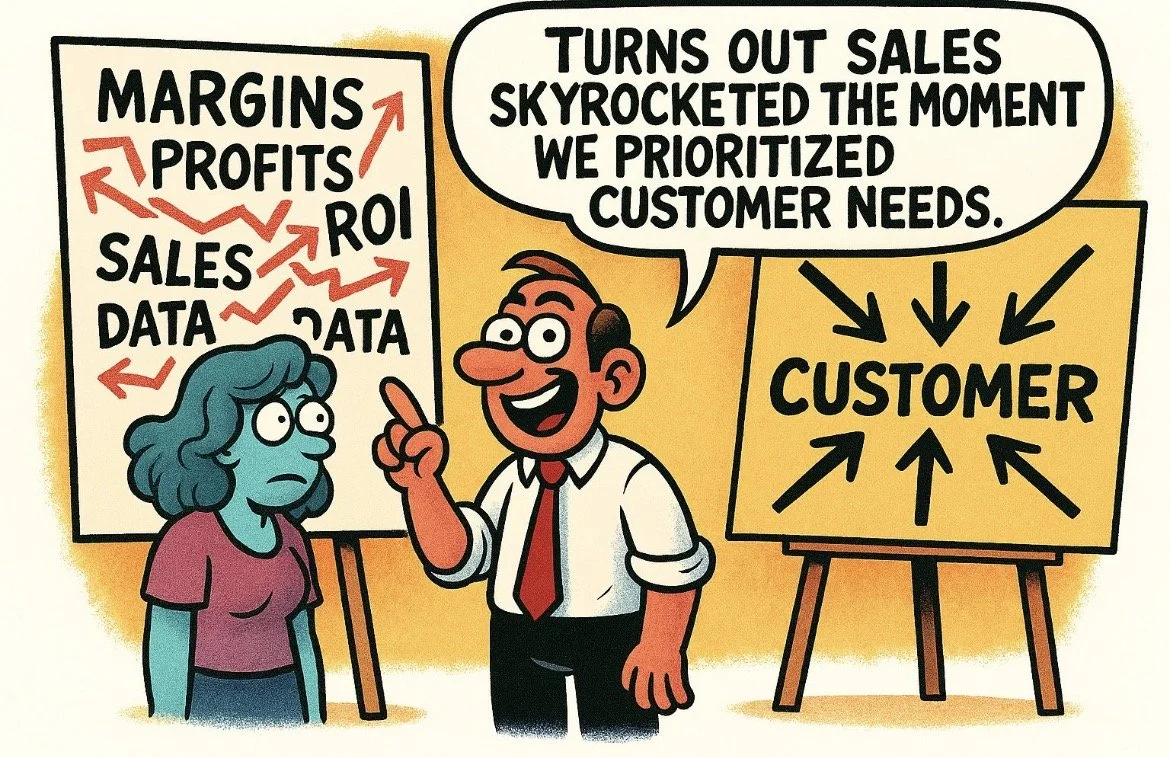
When you audit your weekly performance, what data points dominate your screen? Do you find yourself staring at high-level abstractions like churn rates, renewal percentages, and margin targets, or are you looking deeply at the human problems those numbers are meant to represent? In the high-velocity world of Client Success, have you considered that your most impressive KPIs might actually be trailing indicators of a much simpler, more foundational alignment?
The Hazard of the Abstraction Trap
As a leader in Client Success, you are responsible for maintaining the health of a complex portfolio. It is easy to fall into the "abstraction trap"—a state where you become so focused on the mathematical outputs (the margins and the data) that you lose sight of the primary input: the customer's actual need.
When your strategic focus shifts away from solving real-world problems and moves toward merely hitting a numerical target, you introduce a subtle friction into your organizational culture. Your team begins to prioritize the "scorecard" over the "service," leading to a transactional relationship that clients can sense intuitively. True stewardship in Client Success requires the realization that the metrics are not the mission; they are the feedback loop that tells you how well you are serving the mission.
The Biblical Blueprint for Service and Success
This prioritization of others' needs is not just a modern business tactic; it is a foundational principle of effective stewardship. The Book of Proverbs offers a clear directive for those who seek to build lasting influence through service:
"The soul of the diligent is richly supplied." (Proverbs 13:4, ESV)
In your professional context, diligence is not just about the volume of work, but the direction of that work. When you diligently align your efforts with the "deep hunger" of your client, the "rich supply" of organizational success—the skyrocketing sales and optimized ROI—follows naturally. You don't achieve success by chasing the arrows on the chart; you achieve it by anchoring your hand to the needs of the people you serve.
Executive Competencies: Managing the Human Middleware
How do you shift your internal baseline to ensure your Client Success team remains focused on the primary signal? It requires a disciplined internal state that values truth over optics:
Empathy as a Strategic Asset: You must be "curious about other people" because that empathy is the only thing that drives a genuine interest in solving their unique challenges.
The Discipline of Clarity: Are you "assertive while balancing empathy" when talking to your stakeholders? Sometimes, prioritizing a customer's need means telling a "hard truth" to your own internal team to prevent a system-wide failure in service later.
Relentless Focus on Value: You stay "relentlessly positive" not by ignoring the data, but by focusing your effort on the variables you can control—the quality of your connection and the integrity of your solution.
A Consultation of the Self
As you prepare for your next leadership review, take a moment to inspect your leadership infrastructure. Are you currently leading a "data-driven" team that has forgotten the human driver? Or are you cultivating an environment where success is recognized as the natural byproduct of selfless stewardship?
It turns out that "skyrocketing sales" are rarely the result of a better spreadsheet; they are the result of a better motive. How will you audit your internal baseline today? Are you prepared to lead your cohort back to the place where your "deep gladness" meets the client's "deep hunger"?
The Internal Audit: Evaluating the Mindset Behind Your Success

As we move into the second quarter of 2026, the technical landscape continues to shift under the influence of AI and rapid digital transformation. While much of our focus remains on the "bloom" of our projects—the metrics, the deployments, and the client satisfaction—it is a fitting time to consider the root system. In nature, and in business systems, the health of the visible depends entirely on the integrity of the unseen.
If you are tasked with developing and leading high achievers, have you considered that your greatest obstacle might not be their performance, but the limits of your own self-governance? To steward an organization well, you are responsible for the "internal bedrock" that supports your professional life. Ruth Gotian’s The Success Factor offers a framework to examine this, though the value lies in how you apply it to your specific daily challenges.
Evaluating Your Internal Systems
Consider your current approach to leadership. Are you managing your career and your mindset with the same precision you expect from a high-level business system?
Obstacles vs. Roadblocks: When a project hits a snag, do you see a dead end, or do you see a necessary friction point that reveals where the system needs refinement?
Defining the Finish Line: Do you treat success as a static destination, or do you recognize it as a moving target that requires constant adjustment?
Calendar Stewardship: Are you in control of your schedule and the trajectory of your career, or are you allowing the "urgent" to crowd out the "important"?
Contributing to the Solution: When gaps appear in your organization, are you stepping in to provide the fix, or are you waiting for the environment to change around you?
Discerning the Signal
In our roles, we often deal with data redundancy and signal noise. You may find similar occurrences in Gotian’s work, where certain high-profile examples—such as Olympic athletes or world-renowned researchers—are introduced multiple times as if for the first time.
Additionally, you might notice that the focus leans heavily toward these high-profile figures. As someone managing the high-pressure ripples of technology and client success, you have to do the work of translating their "arena" into yours. The discipline required for an Olympic gold medal is the same discipline you need to maintain your composure and strategy when a system-wide update goes sideways. The setting is different, but the internal requirement remains.
The Foundation of Peak Performance
As you reflect on your own "internal vitality" this Spring, consider these four pillars of stewardship:
Reframing Failure: View setbacks as a standard part of the process—data points that help you recalibrate for a better outcome.
Continuous Growth: Professional development is a cycle that stays open. There is no point where a leader has "arrived" and no longer needs to learn.
The Source of Motivation: Consider whether your drive comes from external accolades or from an internal commitment to do the job well because it is the right thing to do.
Steady Persistence: Success often comes down to the ability to remain steadfast when the initial excitement of a project fades.
Your Next Step
Mindset is not a luxury reserved for the elite; it is a fundamental requirement for anyone entrusted with the stewardship of people, clients, and technology. Your leadership is only as strong as the discipline you maintain when no one is watching.
I encourage you to take ownership of your own development by exploring Ruth Gotian’s The Success Factor. Use it to test your current mindset and strengthen the roots of your leadership for the seasons ahead.
The Cost of Self-Criticism: Stewardship of the Leader’s Narrative
As a leader, have you ever considered that the most influential person you will lead today isn’t the one sitting across the boardroom table, down the hall, or in the next cubicle or workspace over, but the one you see in the mirror every morning?
With the high demands of the modern workplace, we are relentless in our pursuit of operational excellence. We audit our P&Ls, we optimize our supply chains, create operational efficiencies, and we refine our go-to-market strategies. Yet, there is one critical asset that often goes unmonitored: the leader’s internal dialogue. How many of you have seen seasoned VPs and C-Suite executives—brilliant minds with decades of experience—unwittingly sabotage their own executive presence through a habit of subtle, internal self-deprecation?
They wouldn’t dream of speaking to a high-value client or a key stakeholder with disrespect, yet they allow a narrative of "not enough" to run unchecked in their own minds.
The Diminished Warrior
There is a profound insight often attributed to an ancient Samurai proverb that serves as a sobering warning for the modern executive:
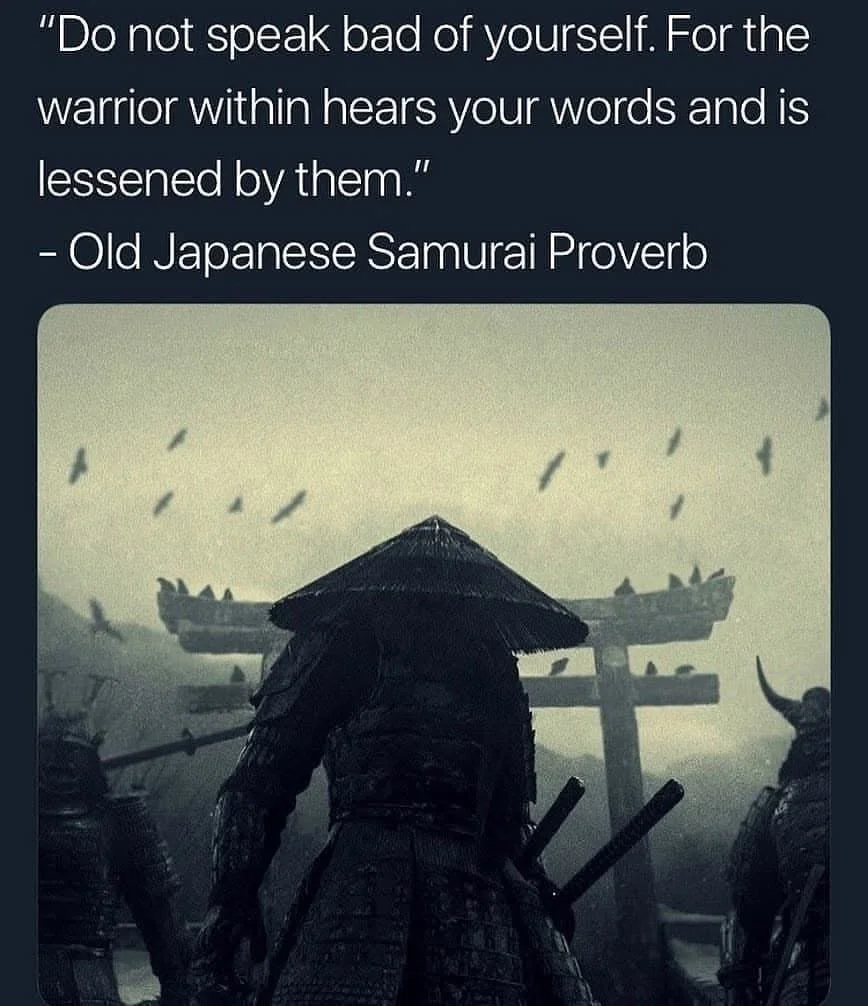
"Do not speak bad of yourself. For the warrior within hears your words and is lessened by them."
In professional leadership, that "warrior within" is your Executive Presence. It is the source of your decisiveness, your emotional intelligence, and your ability to project calm during a corporate crisis. When you speak poorly of yourself—even in the privacy of your own thoughts—you are not being "humble." You are actually diminishing the very tool you use to lead.
If you view yourself as "just a placeholder" or "lucky to be here," your non-verbal cues will eventually betray you. Your posture, your tone, and your willingness to take calculated risks will all be "lessened" because you have effectively told your inner self that you are not up to the task.
The Stewardship of the Tongue
This principle of self-talk is more than psychological; it is a matter of stewardship. In the English Standard Version of the Bible, we are reminded: "Whoever keeps his mouth and his tongue keeps himself out of trouble" (Proverbs 21:23).
Leadership is the stewardship of influence. If you are to be a good steward of your organization, you must first be a good steward of your own mind and words. You cannot build a culture of excellence and confidence in your department if you are building a culture of deficiency within yourself.
Shifting the Narrative
To lead at the highest level, you must audit your internal narrative with the same rigor you apply to your annual budget.
Identify the "Subtle Leak": High-level leaders rarely engage in blatant self-insult. Instead, it’s a subtle leak: "I’m not as visionary as the CEO," or "I’m just an operations person." These labels limit your strategic reach. Recognize them as "leadership debt" that needs to be cleared.
Speak with Authority, Even in Private: Stewardship of self-talk means replacing "I can't" or "I'm not" with "I am learning" or "I am responsible for." This isn't about ignoring weaknesses; it’s about acknowledging your capacity to grow into the requirements of your role.
The Ripple Effect: When a leader carries themselves with a quiet, grounded confidence, it creates a "psychological safety" for the entire organization. Your team needs a leader who is not "lessened." They need a warrior who is whole, focused, and aware of their own value.
Final Thought
Your organization deserves the best version of your leadership. That version is not found in a state of self-diminishment, but in a state of high-EQ self-awareness and professional dignity. Your "warrior within" is listening to every word you say.
What is one self-limiting belief you’ve been carrying that is currently "lessening" your impact in the boardroom? How would your leadership change if you replaced it with a commitment to stewardship and growth?