

BLOG POSTS
The Core Discipline: Unlocking Strategic Power Through Gratitude

You are constantly being asked to do more with less—to accelerate transformation, to reduce technical debt, and to secure the loyalty of high-value clients. In this unrelenting pursuit of the next objective, it is easy to fall into the demanding trap of focusing solely on what is missing or broken. But what if the next level of strategic power and influence you seek isn't found in a new budget line or a cutting-edge tool, but in a simple, internal discipline? Are you unintentionally draining your strategic power by neglecting the discipline of gratitude for what you already have?
The Abundance Engine: Gratitude as a Force Multiplier
For seasoned leaders across Client Success, IS, and IT, the professional environment can often feel like a landscape of perpetual need. We are measured by gaps: the gap between current and desired state, the gap in system stability, or the gap in client retention targets. This focus on deficits, while necessary for problem-solving, can erode our vision and our endurance.
Elizabeth Kübler-Ross, renowned for her deep insight into the human condition, provided a powerful corrective that translates directly to strategic leadership:
“A grateful person is a powerful person, for gratitude generates power. All abundance is based upon being grateful for what we have.” (Elisabeth Kübler-Ross, The Wheel of Life: A Memoir)
This statement suggests that true strategic power is not merely accumulated through external assets but is generated internally through perspective. Gratitude fundamentally shifts the organizational narrative from one of scarcity to one of sufficiency. When you, as a leader, genuinely cultivate thanks, you unlock three critical strategic advantages for your organization:
1. Amplified Vision and Clarity
A perspective rooted in thanks provides immediate, vital clarity. When you step back from the tactical urgency and recognize the abundance of talent, the reliability of current platforms, and the historical client partnerships you possess, you are empowered. This focus allows you to see the current strengths—the assets—available to you, rather than being paralyzed by the perceived threats or limitations. You replace the anxiety of scarcity with the confident assurance necessary to set a clear, focused strategic course.
2. The Client Success Multiplier
In CSM, the ability to handle a crisis—a critical bug, a service disruption, or a challenging renewal—is often the true measure of leadership. When your team operates from a position of chronic complaint or stress over what is lacking, client escalations feel like an overwhelming burden.
However, a leadership team that models gratitude—for the challenging but valuable client, for the talented specialists working overtime, and for the infrastructure that did not fail—fosters resilience. Gratitude acts as a relational multiplier. It conveys strength and stability, demonstrating to your clients and your team that while you may face difficulty, you do so with composure and perspective, viewing problems as challenges to overcome with the resources you have, not impossible walls to breach.
3. Retention and Culture Fuel
In the competitive IS/IT labor market, your culture is your greatest retention tool. You can pay market rate, but you cannot buy loyalty.
When you, as a leader, prioritize expressing sincere gratitude for the diligence of your engineers, the consistency of your system administrators, and the endurance of your functional leads, you are not simply being polite—you are funding their commitment. Your genuine thanks for their character and commitment transforms transactional work into meaningful contribution. This discipline of thanksgiving, far from being a soft virtue, is an essential component of a psychologically resilient and high-performing technical culture.
The Discipline of the Powerful Leader
Leading from a position of gratitude is a discipline, not merely a fleeting emotion. It requires a deliberate, daily commitment to recognize the good—the provision, the capability, and the strength—that underpins the complexity of your enterprise.
Your strategic power is not limited by your current budget or your Headcount FTE. It is limited by the perspective from which you choose to operate. By centering your leadership on gratitude, you tap into an inexhaustible source of power, vision, and enduring influence, shaping your organization not by the crises you manage, but by the abundance you recognize.
The Cost of Self-Criticism: Stewardship of the Leader’s Narrative
As a leader, have you ever considered that the most influential person you will lead today isn’t the one sitting across the boardroom table, down the hall, or in the next cubicle or workspace over, but the one you see in the mirror every morning?
With the high demands of the modern workplace, we are relentless in our pursuit of operational excellence. We audit our P&Ls, we optimize our supply chains, create operational efficiencies, and we refine our go-to-market strategies. Yet, there is one critical asset that often goes unmonitored: the leader’s internal dialogue. How many of you have seen seasoned VPs and C-Suite executives—brilliant minds with decades of experience—unwittingly sabotage their own executive presence through a habit of subtle, internal self-deprecation?
They wouldn’t dream of speaking to a high-value client or a key stakeholder with disrespect, yet they allow a narrative of "not enough" to run unchecked in their own minds.
The Diminished Warrior
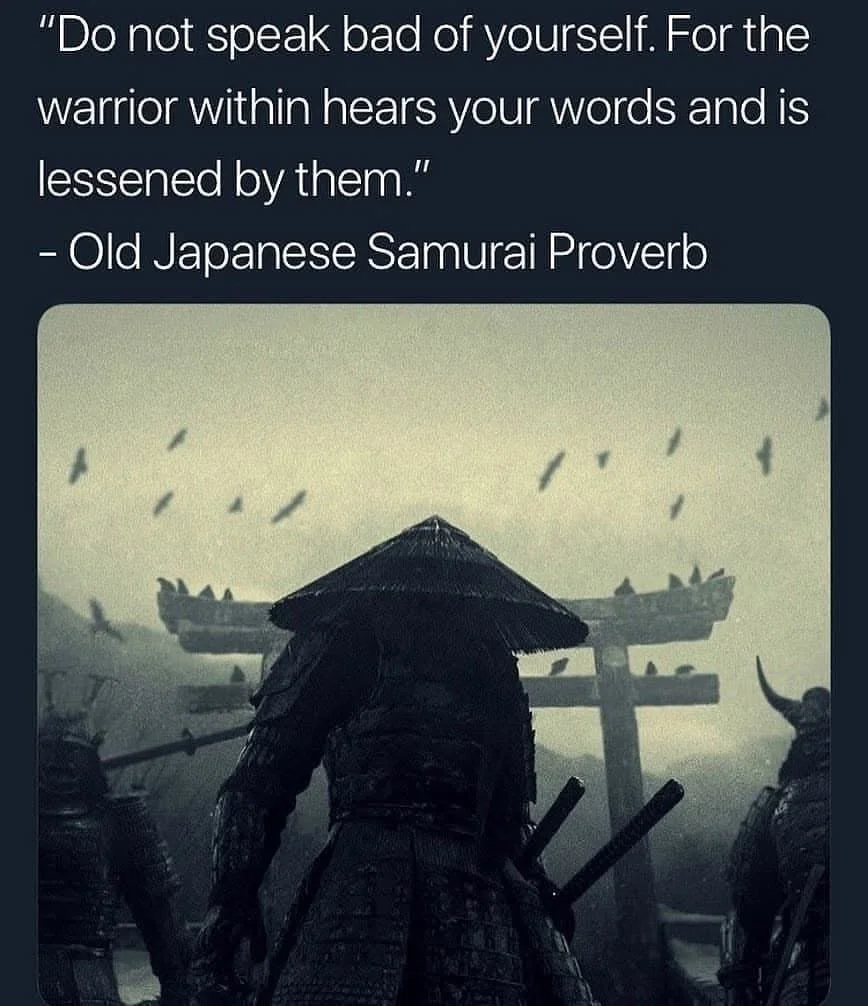
There is a profound insight often attributed to an ancient Samurai proverb that serves as a sobering warning for the modern executive:
"Do not speak bad of yourself. For the warrior within hears your words and is lessened by them."
In professional leadership, that "warrior within" is your Executive Presence. It is the source of your decisiveness, your emotional intelligence, and your ability to project calm during a corporate crisis. When you speak poorly of yourself—even in the privacy of your own thoughts—you are not being "humble." You are actually diminishing the very tool you use to lead.
If you view yourself as "just a placeholder" or "lucky to be here," your non-verbal cues will eventually betray you. Your posture, your tone, and your willingness to take calculated risks will all be "lessened" because you have effectively told your inner self that you are not up to the task.
The Stewardship of the Tongue
This principle of self-talk is more than psychological; it is a matter of stewardship. In the English Standard Version of the Bible, we are reminded: "Whoever keeps his mouth and his tongue keeps himself out of trouble" (Proverbs 21:23).
Leadership is the stewardship of influence. If you are to be a good steward of your organization, you must first be a good steward of your own mind and words. You cannot build a culture of excellence and confidence in your department if you are building a culture of deficiency within yourself.
Shifting the Narrative
To lead at the highest level, you must audit your internal narrative with the same rigor you apply to your annual budget.
Identify the "Subtle Leak": High-level leaders rarely engage in blatant self-insult. Instead, it’s a subtle leak: "I’m not as visionary as the CEO," or "I’m just an operations person." These labels limit your strategic reach. Recognize them as "leadership debt" that needs to be cleared.
Speak with Authority, Even in Private: Stewardship of self-talk means replacing "I can't" or "I'm not" with "I am learning" or "I am responsible for." This isn't about ignoring weaknesses; it’s about acknowledging your capacity to grow into the requirements of your role.
The Ripple Effect: When a leader carries themselves with a quiet, grounded confidence, it creates a "psychological safety" for the entire organization. Your team needs a leader who is not "lessened." They need a warrior who is whole, focused, and aware of their own value.
Final Thought
Your organization deserves the best version of your leadership. That version is not found in a state of self-diminishment, but in a state of high-EQ self-awareness and professional dignity. Your "warrior within" is listening to every word you say.
What is one self-limiting belief you’ve been carrying that is currently "lessening" your impact in the boardroom? How would your leadership change if you replaced it with a commitment to stewardship and growth?