

BLOG POSTS
The Core Metric: Is Your Success Architecture Truly Client-Centric?
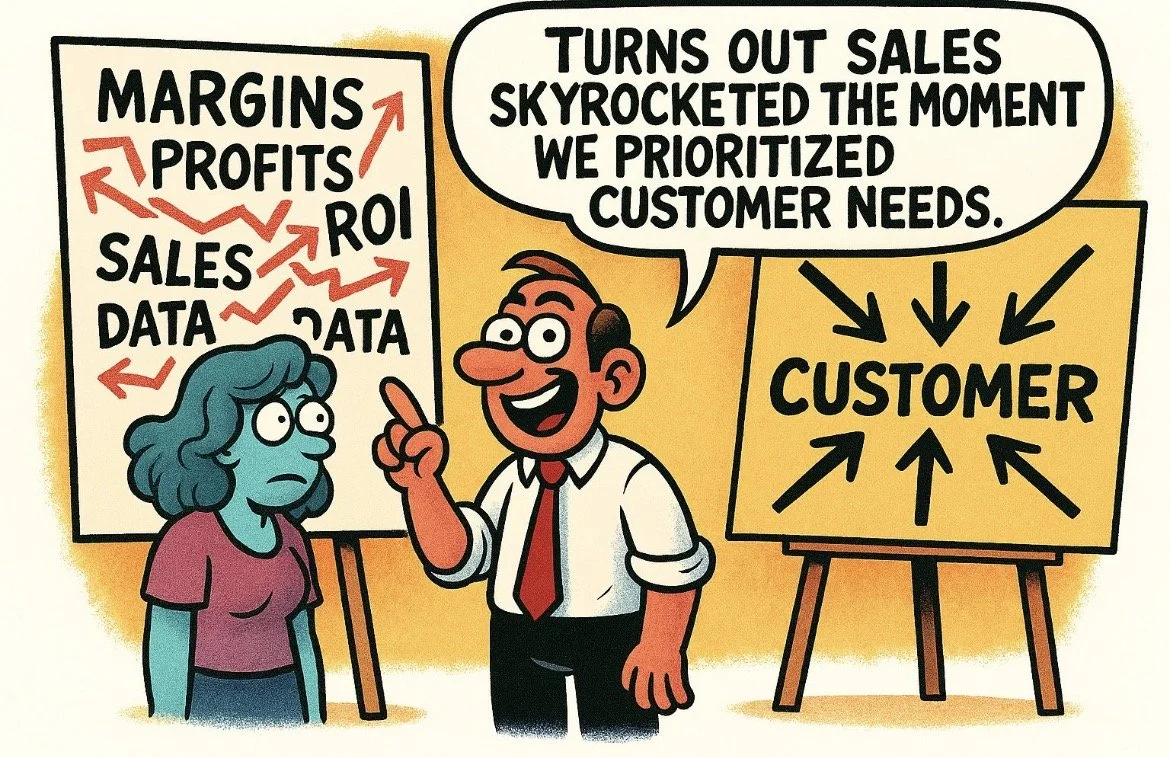
When you audit your weekly performance, what data points dominate your screen? Do you find yourself staring at high-level abstractions like churn rates, renewal percentages, and margin targets, or are you looking deeply at the human problems those numbers are meant to represent? In the high-velocity world of Client Success, have you considered that your most impressive KPIs might actually be trailing indicators of a much simpler, more foundational alignment?
The Hazard of the Abstraction Trap
As a leader in Client Success, you are responsible for maintaining the health of a complex portfolio. It is easy to fall into the "abstraction trap"—a state where you become so focused on the mathematical outputs (the margins and the data) that you lose sight of the primary input: the customer's actual need.
When your strategic focus shifts away from solving real-world problems and moves toward merely hitting a numerical target, you introduce a subtle friction into your organizational culture. Your team begins to prioritize the "scorecard" over the "service," leading to a transactional relationship that clients can sense intuitively. True stewardship in Client Success requires the realization that the metrics are not the mission; they are the feedback loop that tells you how well you are serving the mission.
The Biblical Blueprint for Service and Success
This prioritization of others' needs is not just a modern business tactic; it is a foundational principle of effective stewardship. The Book of Proverbs offers a clear directive for those who seek to build lasting influence through service:
"The soul of the diligent is richly supplied." (Proverbs 13:4, ESV)
In your professional context, diligence is not just about the volume of work, but the direction of that work. When you diligently align your efforts with the "deep hunger" of your client, the "rich supply" of organizational success—the skyrocketing sales and optimized ROI—follows naturally. You don't achieve success by chasing the arrows on the chart; you achieve it by anchoring your hand to the needs of the people you serve.
Executive Competencies: Managing the Human Middleware
How do you shift your internal baseline to ensure your Client Success team remains focused on the primary signal? It requires a disciplined internal state that values truth over optics:
Empathy as a Strategic Asset: You must be "curious about other people" because that empathy is the only thing that drives a genuine interest in solving their unique challenges.
The Discipline of Clarity: Are you "assertive while balancing empathy" when talking to your stakeholders? Sometimes, prioritizing a customer's need means telling a "hard truth" to your own internal team to prevent a system-wide failure in service later.
Relentless Focus on Value: You stay "relentlessly positive" not by ignoring the data, but by focusing your effort on the variables you can control—the quality of your connection and the integrity of your solution.
A Consultation of the Self
As you prepare for your next leadership review, take a moment to inspect your leadership infrastructure. Are you currently leading a "data-driven" team that has forgotten the human driver? Or are you cultivating an environment where success is recognized as the natural byproduct of selfless stewardship?
It turns out that "skyrocketing sales" are rarely the result of a better spreadsheet; they are the result of a better motive. How will you audit your internal baseline today? Are you prepared to lead your cohort back to the place where your "deep gladness" meets the client's "deep hunger"?
The Speed Trap: Is Hurry Compromising Your Leadership Integrity?

In the high-pressure ecosystems of Information Systems and Client Success, how often do you find yourself conflating velocity with effectiveness? When every sprint is labeled "critical" and every outage triggers an immediate escalation, do you recognize the point where your operational urgency begins to cannibalize your strategic impact?
If you were to audit your leadership infrastructure right now, what would you discover about the quality of your presence?
For the C-Suite and seasoned architects driving enterprise-level initiatives, the "tyranny of the urgent" is rarely a scheduling conflict—it is an architectural flaw. Consider the insight of John Ortberg, PhD:
"The most serious sign of hurry sickness is a diminished capacity to love. Love and hurry are fundamentally incompatible. Hurry is not a disordered schedule; it's a disordered heart."
In your world, "love" is the essential cooling system of the engine. It is the intentional care, patience, and professional conduct that regulates the heat generated by high-stakes initiatives. When your internal "heart" is disordered by hurry, you introduce a systemic friction—a thermal overload—that no amount of technical precision can override. Without this regulation, the very systems you are trying to accelerate will eventually seize.
The Diagnostic: Measuring the Cost of Internal Friction
How does a "disordered heart" manifest as measurable risk within your organization? Evaluate your current leadership state against these three strategic constraints:
1. The Erosion of Strategic Foresight
Does your current pace allow for the deep, non-urgent thought required of a Principal Engineer or VP? When your internal state is hurried, your perspective narrows to the reactive "now." You lose the capacity to observe subtle market signals or assess the non-verbal cues from your stakeholders.
The Question: Are you prioritizing the temporary "patch" over the sustainable "architecture" because your internal clock refuses to allow for patient observation?
2. The Degradation of Client and Team Trust
In Client Success, value is built on the perceived sense of partnership. When you enter a boardroom or a one-on-one with a hurried spirit, what does your impatience communicate to the person across from you? Does your lack of presence signal that they are merely an obstacle to your next objective?
The Question: Is your "hurry sickness" creating a fragile environment where teams are hesitant to bring you complex challenges because they sense you have no space to receive them?
3. The Compromise of Technical and Professional Integrity
System stability requires a steady hand. When you allow your internal operating system to be dictated by external clamor, you risk losing the self-mastery required to lead by example. Impatience is a direct threat to the diligence and integrity that define your reputation.
The Question: If your professional conduct is the "interface" through which your team accesses your wisdom, is that connection currently suffering from high latency and dropped packets?
The Strategic Pivot
The most impactful shift you can make is not an optimization of your calendar, but a recalibration of your internal state. Kindness and compassion act as the structural dampeners of leadership; they absorb the shocks of high-growth cycles and prevent the cracks of organizational burnout.
A stable, intentional leader understands that true ROI is found in the time required to be present, thoughtful, and patient. This is the bedrock upon which all technical excellence and client loyalty are built.
Are you prepared to audit your internal narrative to ensure your "heart" supports the scale of the enterprise you are building?
The True North of Leadership: Are Your Actions Telling the Right Story?

In the demanding world of Client Success and Information Systems, we often operate under the conviction that our Strategic Action Plan or our KPI dashboard defines our success. We push our teams to do more, implement faster, and achieve higher numbers. But what if the most powerful force shaping your leadership legacy—and the loyalty of your team—isn’t what you do, but something far more foundational? Are you leading your organization based on what you love more than what you know?
The Unseen Anchor of Leadership
The technical marketplace is a crucible of urgency. Whether rolling out a complex digital transformation initiative or fighting to preserve a critical client relationship, the pressure to execute is immense. We rightfully focus on metrics, governance, and effective workflow. Yet, for leaders operating at the VP and C-Suite levels in SMB and mid-market companies, the difference between transactional management and transformative leadership often comes down to an internal, often neglected quality.
Centuries ago, Augustine Aurelius distilled a profound truth about human character that holds immense resonance for today’s executive:
“We are shaped most by what we think, not by what we do, but by what we love. For when we ask whether somebody is a good person, we are not asking what he believes or hopes for, but what he loves.” (Augustine Aurelius, De Trinitate, Book IX)
This statement is not merely philosophical; it is a critical strategic insight. In the context of leadership, what you love—what you value, prioritize, and genuinely care about—serves as the unseen anchor that determines your decisions, your relational style, and the ultimate health of your organization.
The Strategic Alignment of Affection
For the leader in Client Success (CSM) or Information Systems (IS/IT), what does it mean to be judged by what you love?
1. The Love of the Mission Over the Method
Many experienced technical leaders know they should prioritize the client experience or system reliability. But if your deepest affection is rooted in the perfection of the method (e.g., maintaining rigid legacy processes, proving the technical superiority of a chosen stack, or protecting a departmental budget), your leadership will be rigid.
Challenge for You: When facing a critical decision—be it a system overhaul or a client escalation—where does your attention land first? On preserving your operational comfort, or on the success of the outcome for the organization and the client? Your genuine love for the mission (delivering value, enabling the business, upholding integrity) must supersede your attachment to the process.
2. The Love of People Over Productivity
In technology, it is easy to view engineers, CSMs, and specialists as highly effective resources to be managed for optimal output. While performance is non-negotiable, a leader whose core love is the well-being and development of the individual will naturally inspire profound commitment.
This is not a soft approach; it is strategic wisdom. When you genuinely love to see your people grow and succeed, you invest time in mentoring, you offer constructive correction, and you advocate for their future. This leadership style is felt—it creates loyalty, reduces costly churn in specialized roles, and fosters a culture of mutual respect where people give their best, not just their obligated minimum.
3. The Love of Clarity Over Control
For leaders operating at the top of an organization, the temptation to hoard information and maintain tight control is a constant challenge. However, true strength lies in a love for Clarity—the commitment to transparent, unambiguous communication, even when the news is difficult.
When your primary desire is to maintain Control, you create bottlenecks and breed suspicion. When your true love is for Clarity, you empower your seasoned individual contributors and managers with the context they need to make intelligent, localized decisions. You trust the individuals you hired and align your team to the strategic intent of the organization, freeing your own time for higher-level thinking and external engagement.
The Call to Examine Your Heart’s Motives
The complexity of the SMB and mid-market landscape demands leaders who are not only competent in action but sound in character. Your success is not merely a reflection of the latest quarterly numbers, but a reflection of the deep-seated values you carry into every meeting, negotiation, and one-on-one conversation.
As you step into your next strategic challenge, take a moment to pause and consider the truth of Augustine’s words. Ask yourself: What does my leadership truly love?
The answer will be clearly demonstrated not through your email signature or your formal job description, but through the non-verbal cues your team reads, the decisions you make under pressure, and the loyalty you command when times are difficult. Lead with strategic affection, and watch your organization thrive.
The Scarred Face of Leadership: Why We Must Step Into the Arena

How often have you been in a meeting—maybe about a failed digital transformation project, a major system outage, or a key client churn—where the loudest voices belonged to those who were never actually accountable for the outcome? You know the scenario: the armchair quarterback ready to dissect every mistake, having never been under fire themselves. It's a frustrating dynamic that poisons the growth and strategic daring essential for any scaling SMB or mid-market organization. As leaders in Client Success and Information Systems, we are constantly faced with immense complexity, finite resources, and the relentless pressure to deliver. The question isn't whether we'll fail, but how we'll respond when we do.
The True Measure of Professional Leadership
For those of us working at the nexus of technology (IT/IS) and customer retention (Client Success), our daily reality is the high-stakes 'arena.' We don't get the luxury of theoretical debates; we are focused on deploying systems, protecting data, securing adoption, and ensuring our technology directly translates into client value and operational efficiency. When the network goes down or a key integration fails, it's our team's face that is marred by the proverbial dust and sweat.
In this environment, success isn't defined by the absence of problems, but by the relentless commitment to solving them. We must deliberately cultivate a culture where the effort—the striving—is honored above the outcome alone, and where strategic risk-taking is encouraged, not penalized.
Escaping the Critic's Circle
The biggest threat to high-performing teams isn't technical debt; it's leadership cowardice—the retreat into process paralysis or a fear of making the difficult, often unpopular, decision. Strategic leaders understand that significant achievement requires significant exposure to risk. They also recognize that fostering a climate of external critique without internal support stifles innovation and trust.
When a major initiative stalls, the focus of strategic leadership should not be on assigning blame, but on deconstructing the failure for maximal learning and rapid correction.
This mindset is perfectly captured by Theodore Roosevelt in his famous 1910 address, "Citizenship in a Republic":
"It is not the critic who counts; not the man who points out how the strong man stumbles, or where the doer of deeds could have done them better. The credit belongs to the man who is actually in the arena, whose face is marred by dust and sweat and blood; who strives valiantly; who errs, who comes short again and again, because there is no effort without error and shortcoming; but who does actually strive to do the deeds; who knows great enthusiasms, the great devotions; who spends himself in a worthy cause; who at the best, knows in the end the triumph of high achievement, and who at the worst, if he fails, at least fails while daring greatly, so that his place shall never be with those cold and timid souls who neither know victory nor defeat." (Theodore Roosevelt, "Citizenship in a Republic," delivered at the Sorbonne, Paris, April 23, 1910)
Moving from Manager to Arena Leader
As senior managers and leaders in technology and client-facing roles, this quote is our professional mandate. To lead strategically and build enduring relationships, you must:
Prioritize Action Over Perfection: Recognize that the IT landscape in scaling businesses is too dynamic for perfect planning. You must empower your people to make high-quality, high-velocity decisions, even if they occasionally lead to a misstep. The strategic cost of inaction always outweighs the cost of an informed mistake.
Model Resilience and Vulnerability: Your team needs to see you in the arena, too—not just observing from the skybox. When a project goes sideways, your emotional intelligence and non-verbal cues matter most. Do you convey panic and frustration, or do you convey calm resolve and an unshakeable focus on the next step?
Build Professional Trust through Support: The highest form of professional relationship building is the unwavering commitment to supporting your team after a failure. Strategic leaders absorb the organizational pressure and shield their doers, ensuring that the necessary post-mortem learning is conducted without the distraction of punitive scrutiny.
In the fast-moving, high-pressure world of mid-market technology and client success, we must be the people who "spend themselves in a worthy cause." Our strategic value is determined by our willingness to step into the fray, face the complexity, and stand beside our teams when they are striving valiantly—dust, sweat, and blood included.
What's Your Arena?
What critical, high-stakes project is your team currently tackling, and how are you ensuring they feel supported enough to "fail while daring greatly"?