

BLOG POSTS
The Architecture of Quietude: Auditing the Executive Soul

When the stakes are high and the room goes quiet, here’s something worth pondering: What does your internal monologue sound like in that moment? Is it steady and grounded—or busy, calculating, and afraid of what might slip through your fingers?
In the middle of a high‑pressure initiative, it’s easy to get wrapped up in the mechanics—P&L swings, operating metrics, client dynamics, delivery timelines. Those things matter. But beneath all of that is something more fundamental: who you are being internally while all of this is happening.
Marcus Aurelius once asked a question that still lands hard today:
“What are you afraid of losing, when nothing in the world actually belongs to you?”
That idea isn’t about disengagement or indifference. It’s about ownership versus stewardship.
If you see your role, your team, and even your results as possessions to protect, anxiety is almost guaranteed. But if you see them as a trust you’ve been asked to steward well, something shifts. The internal posture moves from fear to responsibility—from tension to quiet authority.
Your Internal Narrative Is the Blueprint
The conversation you have with yourself is the foundation of your executive presence. It determines whether people experience calm leadership or reactive management when you walk into the room.
Something else worth asking: When you listen closely to that internal narrative, do you hear the voice of a disciplined steward—or someone feeling pushed around by circumstances?
There’s a line from Proverbs that has followed me for years:
“Keep your heart with all vigilance, for from it flow the springs of life.” (Proverbs 4:23, ESV)
In leadership terms, those “springs” are the clarity, steadiness, and integrity you bring into every interaction. If the source is cluttered with fear—fear of loss, fear of being wrong, fear of slipping status—then the output will reflect it.
Sometimes the most meaningful impact we have on a team isn’t our technical expertise or our grasp of the operating cycle. It’s the discipline of remaining composed when things get uncomfortable.
Cultivating the Warrior Within
I think it helps to reframe leadership here. Leadership isn’t a machine you maintain. It’s more like a garden you cultivate. Processes, systems, and metrics matter—but they’re secondary. The vitality of the steward comes first. When you focus on what’s happening inside, you’re building durability, not just output.
That inner discipline shows up in very practical ways:
Clearer communication - When you’re not worried about “losing” an argument, you can listen long enough to hear what’s true.
Composed conflict resolution - When your identity isn’t tied to being right, you can guide the group toward the best answer—not just your answer.
Better stewardship over time - When the enterprise is a trust instead of a trophy, decisions naturally shift from short‑term survival to long‑term sustainability.
This is where quiet strength pays dividends.
A Moment of Self‑Consultation
As you look toward the next quarter, it’s worth pausing—not to review metrics, but to ask a deeper question: Is my leadership built on temporary gains, or on an unshakeable internal state?
The outcomes we see—team trust, peer respect, financial health—are often lagging indicators. They reflect the person we are becoming when no one is watching. And if nothing in this world truly belongs to us, then something freeing happens.
We’re less afraid.
We’re more grounded.
We lead with confidence that isn’t brittle.
That’s the kind of stewardship organizations quietly rely on—and the kind of leadership worth cultivating.
The Professional Mirage: Is Your Identity Built on Sand or Character?

Image curtesy of Marshal Goldsmith, from a LinkedIn post on February 15, 2026
When you look in the mirror after a grueling day of strategic pivots and system-wide deployments, who is the person looking back? Do you see a title—a VP, a Director, a Principal Engineer—or do you see the human being who inhabits that role? Are you currently navigating the high-stakes environment of Information Systems with the realization that while your office may change, your essential character remains the constant?
The Hazard of the Fused Identity
As a leader responsible for critical business systems and client success, you understand the danger of a single point of failure in an architecture. Yet, have you audited the architecture of your own identity? When your sense of self-worth is fused entirely with your professional title, you inadvertently create a massive strategic vulnerability. You become a leader who rises and falls with every organizational shift, every budget cycle, and every project outcome.
Leadership is an "internal-out" discipline. If your foundation is rooted in the "sand" of a business card, your executive presence will inevitably become brittle under pressure. True stewardship begins with the realization that you are not your job title. You are a human being who has been entrusted with a role, but the role is not the man.
The Unchanging Baseline of the Human Being
Finding your steady state in a high-growth "Spring" requires a return to foundational principles. Consider the wisdom found in the Book of Psalms regarding where a leader’s true value is anchored:
"The lines have fallen for me in pleasant places; indeed, I have a very beautiful inheritance. I bless the Lord who gives me counsel; in the night also my heart instructs me. I have set the Lord always before me; because he is at my right hand, I shall not be shaken." (Psalm 16:6–8, ESV)
To not be "shaken" by the turbulence of the corporate world, you must set your identity on an "inheritance" that a board cannot revoke and a market shift cannot devalue. When your heart—your internal narrative—instructs you based on values rather than titles, you gain an authority that is quiet, steady, and unshakeable.
Vitality Beyond the Business Card
How does this internal distinction influence the presence you project to your cohort and direct reports? A leader who is not defined by their title is a leader who can afford to be truly present. You move from "managing resources" to "mentoring human beings."
The Father, The Mother, The Friend: When you recognize that you are a parent, a spouse, and a friend first, you bring a different kind of "vocation" to the office. You lead with a perspective that understands the "world's deep hunger" for authentic connection.
The Mentor as Learner: Because your self-worth isn't tied to "knowing everything," you become a more curious and effective inquisitor of your own path. You aren't afraid to be wrong because your identity isn't on the line—only the solution is.
Executive Competencies of the Grounded Leader
When you separate your humanity from your hierarchy, your executive competencies actually sharpen. You lead with a "skillful hand" because your "upright heart" is no longer defensive:
Clearer Communication: You speak with "tough kindness" because you aren't trying to protect a professional image; you’re trying to serve the person in front of you.
Composed Conflict Resolution: You can navigate uncomfortable truths without fracturing because you understand that a professional disagreement is not a personal indictment.
Profound Stewardship: You treat your position as a gift to be deployed, not a trophy to be guarded.
A Consultation of the Self
As you prepare to publish your next status report or lead your next town hall, take a moment to look at your personal "dashboard." Is your identity currently a "professional mirage," or is it grounded in the unchanging reality of your character?
You are more than your business card. You are a steward of a vision, but more importantly, you are a human being with an "upright heart" that is called to serve.
The Speed Trap: Is Hurry Compromising Your Leadership Integrity?

In the high-pressure ecosystems of Information Systems and Client Success, how often do you find yourself conflating velocity with effectiveness? When every sprint is labeled "critical" and every outage triggers an immediate escalation, do you recognize the point where your operational urgency begins to cannibalize your strategic impact?
If you were to audit your leadership infrastructure right now, what would you discover about the quality of your presence?
For the C-Suite and seasoned architects driving enterprise-level initiatives, the "tyranny of the urgent" is rarely a scheduling conflict—it is an architectural flaw. Consider the insight of John Ortberg, PhD:
"The most serious sign of hurry sickness is a diminished capacity to love. Love and hurry are fundamentally incompatible. Hurry is not a disordered schedule; it's a disordered heart."
In your world, "love" is the essential cooling system of the engine. It is the intentional care, patience, and professional conduct that regulates the heat generated by high-stakes initiatives. When your internal "heart" is disordered by hurry, you introduce a systemic friction—a thermal overload—that no amount of technical precision can override. Without this regulation, the very systems you are trying to accelerate will eventually seize.
The Diagnostic: Measuring the Cost of Internal Friction
How does a "disordered heart" manifest as measurable risk within your organization? Evaluate your current leadership state against these three strategic constraints:
1. The Erosion of Strategic Foresight
Does your current pace allow for the deep, non-urgent thought required of a Principal Engineer or VP? When your internal state is hurried, your perspective narrows to the reactive "now." You lose the capacity to observe subtle market signals or assess the non-verbal cues from your stakeholders.
The Question: Are you prioritizing the temporary "patch" over the sustainable "architecture" because your internal clock refuses to allow for patient observation?
2. The Degradation of Client and Team Trust
In Client Success, value is built on the perceived sense of partnership. When you enter a boardroom or a one-on-one with a hurried spirit, what does your impatience communicate to the person across from you? Does your lack of presence signal that they are merely an obstacle to your next objective?
The Question: Is your "hurry sickness" creating a fragile environment where teams are hesitant to bring you complex challenges because they sense you have no space to receive them?
3. The Compromise of Technical and Professional Integrity
System stability requires a steady hand. When you allow your internal operating system to be dictated by external clamor, you risk losing the self-mastery required to lead by example. Impatience is a direct threat to the diligence and integrity that define your reputation.
The Question: If your professional conduct is the "interface" through which your team accesses your wisdom, is that connection currently suffering from high latency and dropped packets?
The Strategic Pivot
The most impactful shift you can make is not an optimization of your calendar, but a recalibration of your internal state. Kindness and compassion act as the structural dampeners of leadership; they absorb the shocks of high-growth cycles and prevent the cracks of organizational burnout.
A stable, intentional leader understands that true ROI is found in the time required to be present, thoughtful, and patient. This is the bedrock upon which all technical excellence and client loyalty are built.
Are you prepared to audit your internal narrative to ensure your "heart" supports the scale of the enterprise you are building?
The Cost of Self-Criticism: Stewardship of the Leader’s Narrative
As a leader, have you ever considered that the most influential person you will lead today isn’t the one sitting across the boardroom table, down the hall, or in the next cubicle or workspace over, but the one you see in the mirror every morning?
With the high demands of the modern workplace, we are relentless in our pursuit of operational excellence. We audit our P&Ls, we optimize our supply chains, create operational efficiencies, and we refine our go-to-market strategies. Yet, there is one critical asset that often goes unmonitored: the leader’s internal dialogue. How many of you have seen seasoned VPs and C-Suite executives—brilliant minds with decades of experience—unwittingly sabotage their own executive presence through a habit of subtle, internal self-deprecation?
They wouldn’t dream of speaking to a high-value client or a key stakeholder with disrespect, yet they allow a narrative of "not enough" to run unchecked in their own minds.
The Diminished Warrior
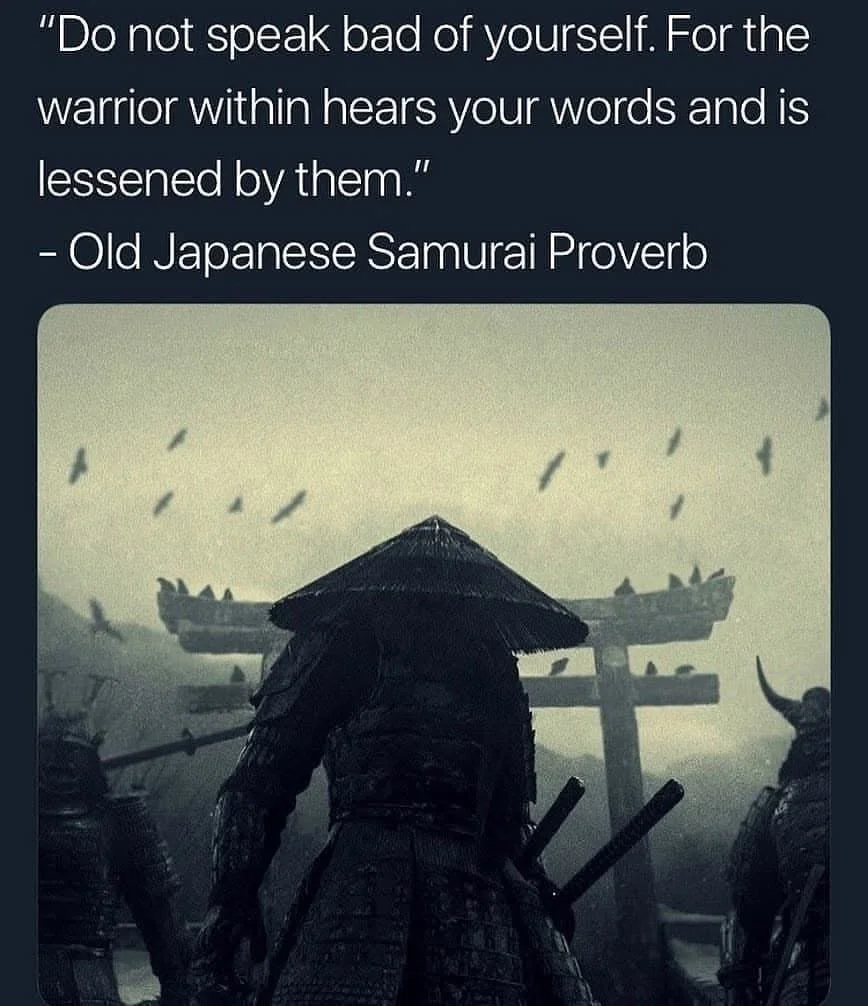
There is a profound insight often attributed to an ancient Samurai proverb that serves as a sobering warning for the modern executive:
"Do not speak bad of yourself. For the warrior within hears your words and is lessened by them."
In professional leadership, that "warrior within" is your Executive Presence. It is the source of your decisiveness, your emotional intelligence, and your ability to project calm during a corporate crisis. When you speak poorly of yourself—even in the privacy of your own thoughts—you are not being "humble." You are actually diminishing the very tool you use to lead.
If you view yourself as "just a placeholder" or "lucky to be here," your non-verbal cues will eventually betray you. Your posture, your tone, and your willingness to take calculated risks will all be "lessened" because you have effectively told your inner self that you are not up to the task.
The Stewardship of the Tongue
This principle of self-talk is more than psychological; it is a matter of stewardship. In the English Standard Version of the Bible, we are reminded: "Whoever keeps his mouth and his tongue keeps himself out of trouble" (Proverbs 21:23).
Leadership is the stewardship of influence. If you are to be a good steward of your organization, you must first be a good steward of your own mind and words. You cannot build a culture of excellence and confidence in your department if you are building a culture of deficiency within yourself.
Shifting the Narrative
To lead at the highest level, you must audit your internal narrative with the same rigor you apply to your annual budget.
Identify the "Subtle Leak": High-level leaders rarely engage in blatant self-insult. Instead, it’s a subtle leak: "I’m not as visionary as the CEO," or "I’m just an operations person." These labels limit your strategic reach. Recognize them as "leadership debt" that needs to be cleared.
Speak with Authority, Even in Private: Stewardship of self-talk means replacing "I can't" or "I'm not" with "I am learning" or "I am responsible for." This isn't about ignoring weaknesses; it’s about acknowledging your capacity to grow into the requirements of your role.
The Ripple Effect: When a leader carries themselves with a quiet, grounded confidence, it creates a "psychological safety" for the entire organization. Your team needs a leader who is not "lessened." They need a warrior who is whole, focused, and aware of their own value.
Final Thought
Your organization deserves the best version of your leadership. That version is not found in a state of self-diminishment, but in a state of high-EQ self-awareness and professional dignity. Your "warrior within" is listening to every word you say.
What is one self-limiting belief you’ve been carrying that is currently "lessening" your impact in the boardroom? How would your leadership change if you replaced it with a commitment to stewardship and growth?
The True North of Leadership: Are Your Actions Telling the Right Story?

In the demanding world of Client Success and Information Systems, we often operate under the conviction that our Strategic Action Plan or our KPI dashboard defines our success. We push our teams to do more, implement faster, and achieve higher numbers. But what if the most powerful force shaping your leadership legacy—and the loyalty of your team—isn’t what you do, but something far more foundational? Are you leading your organization based on what you love more than what you know?
The Unseen Anchor of Leadership
The technical marketplace is a crucible of urgency. Whether rolling out a complex digital transformation initiative or fighting to preserve a critical client relationship, the pressure to execute is immense. We rightfully focus on metrics, governance, and effective workflow. Yet, for leaders operating at the VP and C-Suite levels in SMB and mid-market companies, the difference between transactional management and transformative leadership often comes down to an internal, often neglected quality.
Centuries ago, Augustine Aurelius distilled a profound truth about human character that holds immense resonance for today’s executive:
“We are shaped most by what we think, not by what we do, but by what we love. For when we ask whether somebody is a good person, we are not asking what he believes or hopes for, but what he loves.” (Augustine Aurelius, De Trinitate, Book IX)
This statement is not merely philosophical; it is a critical strategic insight. In the context of leadership, what you love—what you value, prioritize, and genuinely care about—serves as the unseen anchor that determines your decisions, your relational style, and the ultimate health of your organization.
The Strategic Alignment of Affection
For the leader in Client Success (CSM) or Information Systems (IS/IT), what does it mean to be judged by what you love?
1. The Love of the Mission Over the Method
Many experienced technical leaders know they should prioritize the client experience or system reliability. But if your deepest affection is rooted in the perfection of the method (e.g., maintaining rigid legacy processes, proving the technical superiority of a chosen stack, or protecting a departmental budget), your leadership will be rigid.
Challenge for You: When facing a critical decision—be it a system overhaul or a client escalation—where does your attention land first? On preserving your operational comfort, or on the success of the outcome for the organization and the client? Your genuine love for the mission (delivering value, enabling the business, upholding integrity) must supersede your attachment to the process.
2. The Love of People Over Productivity
In technology, it is easy to view engineers, CSMs, and specialists as highly effective resources to be managed for optimal output. While performance is non-negotiable, a leader whose core love is the well-being and development of the individual will naturally inspire profound commitment.
This is not a soft approach; it is strategic wisdom. When you genuinely love to see your people grow and succeed, you invest time in mentoring, you offer constructive correction, and you advocate for their future. This leadership style is felt—it creates loyalty, reduces costly churn in specialized roles, and fosters a culture of mutual respect where people give their best, not just their obligated minimum.
3. The Love of Clarity Over Control
For leaders operating at the top of an organization, the temptation to hoard information and maintain tight control is a constant challenge. However, true strength lies in a love for Clarity—the commitment to transparent, unambiguous communication, even when the news is difficult.
When your primary desire is to maintain Control, you create bottlenecks and breed suspicion. When your true love is for Clarity, you empower your seasoned individual contributors and managers with the context they need to make intelligent, localized decisions. You trust the individuals you hired and align your team to the strategic intent of the organization, freeing your own time for higher-level thinking and external engagement.
The Call to Examine Your Heart’s Motives
The complexity of the SMB and mid-market landscape demands leaders who are not only competent in action but sound in character. Your success is not merely a reflection of the latest quarterly numbers, but a reflection of the deep-seated values you carry into every meeting, negotiation, and one-on-one conversation.
As you step into your next strategic challenge, take a moment to pause and consider the truth of Augustine’s words. Ask yourself: What does my leadership truly love?
The answer will be clearly demonstrated not through your email signature or your formal job description, but through the non-verbal cues your team reads, the decisions you make under pressure, and the loyalty you command when times are difficult. Lead with strategic affection, and watch your organization thrive.
The Unspoken Architecture of Leadership

If you are anything like me, you operate in an industry where precision, logic, and data reign supreme. Every digital transformation roadmap, every critical infrastructure decision, and every budget proposal is meticulously engineered for optimal outcome. Yet, here is the pressing challenge common to every large-scale technology organization: If our strategies are perfectly rational, why do our critical communications—the vendor negotiations, the board presentations, the team-wide pivots—so often fall short of their intended impact?
The truth is, while we focus intensely on what we say, the decisive competitive edge in enterprise leadership is often determined by how we say it and how we show up. The most brilliant strategic vision remains just a document until it is communicated with conviction and received with trust.
This realization led me to Cues: Small Signals, Incredible Impacts by Vanessa Van Edwards. This book is not about mere "soft skills"; it’s a critical read for any senior IT/IS professional who understands that leadership at our level is a high-stakes performance, where the smallest non-verbal signal can either forge trust or introduce crippling doubt.
Here is an executive summary of the cues that resonated most deeply with me and provided direct, actionable insight into elevating our day-to-day engagement with our teams and stakeholders:
Part I: The Strategic Presence – Leveraging "Power Cues"
In the environment of enterprise IT, presence is power—not the power of hierarchy, but the capacity to command attention, articulate certainty, and foster an environment where productive disagreement can thrive, leading to better decisions.
Power Cue #1: Powerful Posture
This is fundamental. Whether you are leading a $100M vendor negotiation or addressing the leadership team after a critical incident, your posture is the first piece of data the room processes. When we are defensive, uncertain, or disengaged, our body language contracts, signals low status, and invites questioning. Powerful Posture—open shoulders, an upright but relaxed frame, and occupying space—communicates competence and resilience. It signals to the room: “I am calm, I am confident, and I am in control of this conversation and the situation at hand.” This is paramount for establishing the psychological safety needed to move complex initiatives forward.
Power Cue #5: Palm Power
Effective leadership demands transparency and a commitment to moving past hidden assumptions. Van Edwards highlights how showing your palms—a gesture historically associated with demonstrating one holds no weapon—is a powerful cue for trust and openness. When you are presenting a solution or asking your team to commit to a difficult initiative, using open-palm gestures makes your delivery appear more honest and authentic. It is a non-verbal confirmation that your motivations are pure and your proposal is well-intended, significantly lowering the audience’s defensive barriers and encouraging buy-in.
Part II: The Vocal Architecture – Mastering "Vocal Cues"
The voice is the delivery mechanism for our strategy, yet many leaders have never truly trained this instrument. Now that remote and hybrid meetings are a constant, the vocal signal is often the only signal we transmit.
Vocal Power Cue #1: How to Sound Confident
Confidence in speech is less about volume and more about control and cadence. Confident speakers avoid "uptalk" (raising the pitch at the end of a statement, turning it into an unintentional question) and utilize strategic pauses. Pausing before a key point not only allows the information to land but also demonstrates self-assurance. It says, “I know what I am about to say is important, and I trust you will wait for it.”
Vocal Power Cue #3: Eliminate Vocal Fry...Forever
While a seemingly minor point, vocal fry (the low, creaky sound at the end of a sentence) disproportionately erodes credibility, particularly in high-stakes environments. It is often perceived, rightly or wrongly, as a sign of apathy, insecurity, or lack of gravitas. As senior leaders, we must be polished communicators. Eliminating this cue ensures that the focus remains on the strategic content and not the vocal distraction.
Vocal Power Cue #4: Volume Control Shows Emotional Control
When under pressure—be it a system outage or a contentious budget review—our natural tendency may be to raise our voice. However, the most emotionally controlled leaders master strategic volume control. A measured, steady volume conveys stability and strategic command. Furthermore, lowering your voice slightly at a critical juncture can force the listener to lean in, capturing their full focus and demonstrating that you are handling the pressure with calm authority.
Vocal Warmth Cue #1: Make a Memorable Vocal First Impression
Warmth is how we build trust. Your vocal first impression should convey that you are not just a technical automaton, but a human leader invested in solving a problem with your audience. This involves using an engaging pitch and a slightly faster-than-average pace to demonstrate enthusiasm, followed by a slight, strategic slowing to ensure clarity and gravity.
Vocal Warmth Cue #3: How to Sound More Interesting
Monotone delivery is the enemy of engagement, particularly when discussing complex technical roadmaps. To sound more interesting, employ vocal variety—changing your pitch, pace, and projection. Emphasize key data points or strategic imperatives with a slight drop in pitch and a deliberate pause. This variation ensures that your audience remains engaged and that your core message penetrates the noise.
The Charismatic Word Choice
Charismatic communication—in both verbal presentations and written executive summaries—is achieved by shifting from technical nomenclature to language that invokes vision and benefit. Instead of focusing on tool names or process steps, focus on the impact to the business, the value created, and the future state you are pursuing. Use powerful, evocative words to frame challenges as opportunities and operational shifts as strategic leaps. This helps you engage your audience not just on a logical level, but on an aspirational one, driving momentum toward organizational goals.
Call to Action
Effective leadership is about maximizing impact through deliberate execution. I highly recommend adding Cues: Small Signals, Incredible Impacts to your reading list. Master these small signals, and you will begin to observe the incredible impact on your ability to lead, persuade, and drive strategic outcomes across the enterprise.