

BLOG POSTS
The Core Metric: Is Your Success Architecture Truly Client-Centric?
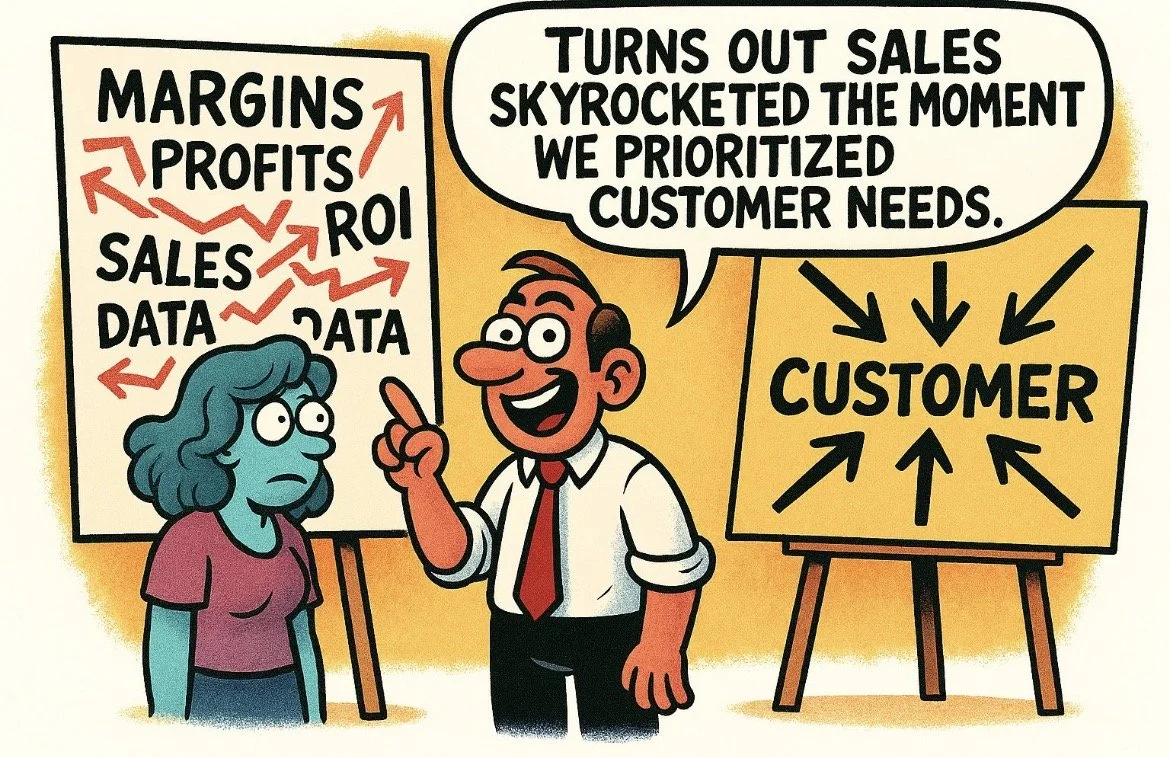
When you audit your weekly performance, what data points dominate your screen? Do you find yourself staring at high-level abstractions like churn rates, renewal percentages, and margin targets, or are you looking deeply at the human problems those numbers are meant to represent? In the high-velocity world of Client Success, have you considered that your most impressive KPIs might actually be trailing indicators of a much simpler, more foundational alignment?
The Hazard of the Abstraction Trap
As a leader in Client Success, you are responsible for maintaining the health of a complex portfolio. It is easy to fall into the "abstraction trap"—a state where you become so focused on the mathematical outputs (the margins and the data) that you lose sight of the primary input: the customer's actual need.
When your strategic focus shifts away from solving real-world problems and moves toward merely hitting a numerical target, you introduce a subtle friction into your organizational culture. Your team begins to prioritize the "scorecard" over the "service," leading to a transactional relationship that clients can sense intuitively. True stewardship in Client Success requires the realization that the metrics are not the mission; they are the feedback loop that tells you how well you are serving the mission.
The Biblical Blueprint for Service and Success
This prioritization of others' needs is not just a modern business tactic; it is a foundational principle of effective stewardship. The Book of Proverbs offers a clear directive for those who seek to build lasting influence through service:
"The soul of the diligent is richly supplied." (Proverbs 13:4, ESV)
In your professional context, diligence is not just about the volume of work, but the direction of that work. When you diligently align your efforts with the "deep hunger" of your client, the "rich supply" of organizational success—the skyrocketing sales and optimized ROI—follows naturally. You don't achieve success by chasing the arrows on the chart; you achieve it by anchoring your hand to the needs of the people you serve.
Executive Competencies: Managing the Human Middleware
How do you shift your internal baseline to ensure your Client Success team remains focused on the primary signal? It requires a disciplined internal state that values truth over optics:
Empathy as a Strategic Asset: You must be "curious about other people" because that empathy is the only thing that drives a genuine interest in solving their unique challenges.
The Discipline of Clarity: Are you "assertive while balancing empathy" when talking to your stakeholders? Sometimes, prioritizing a customer's need means telling a "hard truth" to your own internal team to prevent a system-wide failure in service later.
Relentless Focus on Value: You stay "relentlessly positive" not by ignoring the data, but by focusing your effort on the variables you can control—the quality of your connection and the integrity of your solution.
A Consultation of the Self
As you prepare for your next leadership review, take a moment to inspect your leadership infrastructure. Are you currently leading a "data-driven" team that has forgotten the human driver? Or are you cultivating an environment where success is recognized as the natural byproduct of selfless stewardship?
It turns out that "skyrocketing sales" are rarely the result of a better spreadsheet; they are the result of a better motive. How will you audit your internal baseline today? Are you prepared to lead your cohort back to the place where your "deep gladness" meets the client's "deep hunger"?
Truth's Ascent: Navigating the 3 Stages of Change

We are now well into the first quarter of 2026. By now, the polished slides of your annual kickoff have met the messy reality of daily operations. Are the "truths" you championed in January currently being embraced—or are they quietly being met with the friction of the status quo?
The transition from February to March is often the "make or break" window for digital transformation. It is the season where the novelty wears off and the discipline of leadership begins. If you find your initiatives facing headwinds, it may not be a sign of failure, but rather a sign that your strategy is moving through a predictable, necessary gauntlet.
There is a profound framework for this experience, famously articulated by the philosopher Arthur Schopenhauer in his preface to The World as Will and Representation (1818):
"All truth passes through three stages. First, it is ridiculed. Second, it is violently opposed. Third, it is accepted as self-evident."
For the C-suite leader, VP, or Principal Engineer, these stages aren't just philosophical observations; they are the strategic milestones of any significant change management initiative.
Stage One: The Ridicule of the Unfamiliar
In the fast-paced world of tech and Client Success, new truths often arrive looking like "extra work" or "unnecessary pivots." When you suggest a radical simplification of your tech stack or a shift in how you measure client health, the first response is often a dismissive laugh or a sarcastic comment in the hallway.
As a leader, your role here is not to take offense, but to practice high emotional IQ. Recognize that ridicule is often a mask for a lack of understanding or a fear of the unknown. Can you remain a steady, inquisitive force when your vision is being minimized during these late-winter months?
Stage Two: The Friction of Opposition
As your "truth" gains traction and begins to move from theory to implementation—the phase many of us find ourselves in right now—the opposition often turns from dismissive to defensive. This is the stage of "violent opposition"—not in a physical sense, but through bureaucratic roadblocks, passive-aggressive compliance, or vocal dissent.
In thermodynamics, we know that friction generates heat. In leadership, this heat is often a sign that you are finally touching the core of the problem. It is here that the biblical principle of "speaking the truth in love" (Ephesians 4:15) becomes a strategic imperative. Can you hold the line with authority and compassion, addressing the fear behind the opposition without compromising the integrity of the mission?
Stage Three: The Quiet Power of the Self-Evident
The most rewarding moment for a senior leader is the day the "radical idea" becomes "the way we’ve always done it." The opposition fades, the ridicule is forgotten, and the new system becomes the bedrock of your operational excellence.
However, the trap for the seasoned leader at this stage is pride. When the truth becomes self-evident, the focus should shift back to the team’s success. Your goal was never personal vindication; it was the flourishing of the people and the systems in your care. The goal of a transformative leader isn't to be proven right; it’s to ensure the right path becomes the common path.
Reflective Leadership Audit: The Q1 Check-in
As you evaluate your 2026 strategic initiatives this week, ask yourself:
Where am I in the cycle? Are you currently facing the "ridicule" of a new idea, or are you in the thick of February "opposition"? Identifying the stage helps you calibrate your emotional response.
How do I handle dissent? When a peer or direct report opposes a necessary truth, do you view them as an enemy to be defeated, or a partner who hasn't yet seen the self-evident conclusion?
Is my truth actually true? Before pushing through opposition, have you done the quiet work of self-examination? Does your plan align with the objective reality of your data and the well-being of your team?
Leading through these stages requires a rare blend of iron-clad conviction and humble empathy. By understanding this progression, you can lead your organization through the friction of today into the self-evident successes of tomorrow.